





In the global marketplace for Personal Protective Equipment (PPE), the finished product that arrives at a warehouse or construction site is the silent testament to a vast and complex industrial undertaking. To the end-user, a work glove is a functional tool—a barrier against hazards. However, to the industry insider, a high-quality glove is the result of a sophisticated convergence of chemical engineering, textile technology, and rigorous statistical process control. In an era where supply chain transparency and product reliability are paramount, understanding the intricate details of how a glove is made is no longer just for engineers; it is essential knowledge for procurement managers, safety officers, and business leaders. This comprehensive report peels back the curtain on the manufacturing floor. We will explore the granular details of the production lifecycle, from the molecular auditing of raw polymers to the automated precision of seamless knitting and the scientific rigors of post-production testing. This is the story of how manufacturing excellence transforms raw materials into life-saving protection.
Phase 1: The Foundation – Raw Material Auditing and Preparation
The quality of a finished glove can never exceed the quality of its constituent parts. For a top-tier Original Equipment Manufacturer (OEM) like Shandong Rilong, the manufacturing process begins long before a machine is turned on. It starts with a strict audit of the raw materials: the yarns that form the liner and the chemical emulsions that form the coating.
The Chemistry of Polymers
The performance of coated gloves—whether nitrile, latex, or polyurethane (PU)—is dictated by the stability and purity of the polymer emulsion.
- Viscosity and Solids Content: Upon arrival, chemical engineers test the liquid polymer for Total Solids Content (TSC) and viscosity. If the viscosity is too low, the coating will penetrate the liner (“strike-through”), causing stiffness and skin irritation. If it is too high, the coating will be uneven. Precise control ensures the consistent feel of a lightweight breathable PU glove.
- Compound Maturation: Raw nitrile or latex must be “compounded” with vulcanizing agents (sulfur, zinc oxide) and accelerators. This mixture requires a specific maturation period—often 24 to 48 hours—under controlled agitation to ensure the chemical bonds will form correctly during curing.
The Engineering of Yarns
The mechanical protection (cut and abrasion resistance) comes from the yarn.
- Tensile Testing: Batches of High-Performance Polyethylene (HPPE), Aramid, or polyester yarn are subjected to tensile strength tests to ensure they meet the denier specifications. This is critical for producing certified Level 5 anti-cut gloves.
- Moisture Content: For natural fibers like cotton used in PVC dotted gloves, moisture content is checked to prevent mold or knitting irregularities.
Phase 2: The Knitting Hall – Automated Precision
The modern knitting hall is a hive of automation. Rows of computerized knitting machines work simultaneously to produce the seamless liners that are the backbone of the glove industry.
Gauge Selection and Stitch Density
The “gauge” of a machine refers to the number of needles per inch. Manufacturing excellence requires a diverse fleet of machines to cover all applications.
- 7-Gauge and 10-Gauge: These machines use thicker yarns to produce heavy-duty liners. This is typical for winter gloves or heavy industrial gloves where cushioning is required.
- 13-Gauge and 15-Gauge: The industry standard for general handling. A 13-gauge machine produces the ubiquitous 13G polyester liner, offering a balance of durability and dexterity.
- 18-Gauge and 21-Gauge: The frontier of knitting technology. These ultra-fine machines produce liners that feel like a second skin, essential for precision assembly tasks.
In-Process Knitting QC
Automated sensors on the knitting machines detect broken threads or dropped stitches immediately. However, human inspection is still vital. Technicians perform random weight checks on the knitted liners. A liner that is even a few grams underweight indicates a deviation in yarn tension or density, which could compromise the final cut-resistance rating of an anti-cut glove.
Phase 3: The Dipping Line – Where Chemistry Meets Mechanics
The transition from a textile liner to a coated safety glove happens on the dipping line. This is a massive, continuous conveyor system that can span hundreds of feet. The process is a delicate balance of thermodynamics and fluid dynamics.
Step 1: Loading and Singeing
Liners are stretched onto ceramic hand formers. These formers are anatomically shaped to ensure the final glove fits the human hand correctly. In some high-end lines, the liners pass through a gas flame (singeing) to burn off loose fibers, ensuring a smooth surface for the coating.
Step 2: The Coagulant Bath
Before the polymer, the formers are dipped into a coagulant solution (typically calcium nitrate or calcium chloride). This chemical acts as a bonding agent.
- Process Control: The concentration of the coagulant determines how quickly the polymer gels. A precise concentration is needed to prevent the polymer from soaking through the liner. For a nitrile palm coated glove, the coagulant is applied only to the palm area to define the coating line.
Step 3: Polymer Dipping
The formers descend into the tank of liquid polymer.
- Profile Control: The angle of entry and exit is computer-controlled to ensure an even coating thickness and to prevent drips or “runs” at the fingertips.
- Specialized Finishes: To achieve a micro-foam finish, the polymer is aerated before dipping. To achieve a sandy finish, the wet glove passes through a salt or media blaster that embeds particles into the surface before curing.
Step 4: Vulcanization (Curing)
The gloves travel through long ovens with multiple temperature zones, ranging from 100°C to 140°C. This heat triggers the cross-linking of the polymer chains (vulcanization), transforming the liquid coating into a tough, solid, and elastic film.
- Critical Control Point: If the temperature is too low, the glove will be tacky and weak. If too high, it becomes brittle. Continuous temperature monitoring is essential for the durability of heavy-duty gloves.
Step 5: Leaching and Washing
High-quality manufacturing involves an extensive leaching process. The gloves are washed in hot water tanks to remove residual chemicals, proteins (in latex), and excess coagulants. This step is vital for preventing skin irritation and ensuring the glove is clean and safe for the wearer.
Phase 4: Post-Production Processing and Finishing
Once removed from the formers, the gloves are not yet finished. They undergo secondary processes that enhance their functionality and marketability.
Tumbling and Cooling
Gloves are tumbled in large industrial dryers to remove any remaining moisture and to soften the coating, improving the “hand feel.”
Printing and Branding
For OEM clients, this is where the brand identity is applied. Ink transfer or screen printing is used to apply the logo, size, and CE/ANSI certification marks on the back of the glove. The legibility of these marks is a compliance requirement.
Sewing and Overlocking
The cuff of the glove is finished with an “overlock” stitch. This color-coded stitching usually indicates the size of the glove (e.g., Red for Large, Yellow for Medium). This simple visual aid is crucial for inventory management on a busy job site.
Phase 5: The Laboratory – Scientific Verification
A manufacturing facility without a laboratory is merely a factory; with a laboratory, it is a center of engineering. Top-tier manufacturers conduct rigorous batch testing to verify compliance with international standards.
Mechanical Testing (EN 388 / ANSI 105)
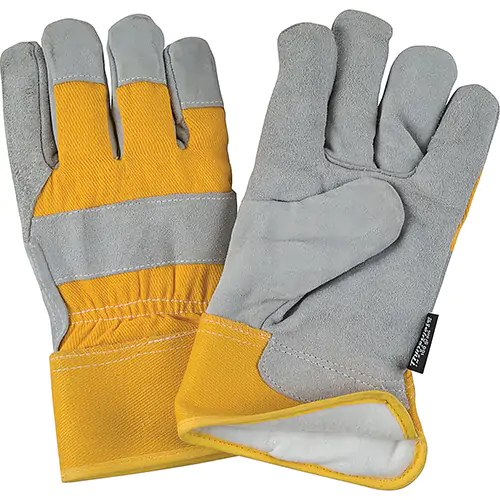
- Abrasion Testing: Samples are placed in a Martindale abrasion machine, where they are rubbed against a standardized abrasive paper. The number of cycles to breakthrough determines the abrasion level. This ensures leather work gloves meet the expectations for heavy construction.
- Cut Resistance (TDM-100): The TDM-100 machine uses a straight blade and variable weights to measure the force required to cut the fabric. This is the only way to accurately certify a glove as HPPE anti-cut compliant.
- Puncture and Tear: Specialized tensometers measure the force required to puncture the palm with a steel stylus or tear the material apart.
Chemical Permeation Testing (EN 374)
For chemical resistant gloves, samples are exposed to specific chemicals (acids, solvents). Sensors measure the time it takes for the chemical to permeate the material at a molecular level. This data is critical for generating the chemical resistance charts that safety managers rely on.
Phase 6: Quality Assurance and AQL Standards
Before shipment, the final barrier is the Quality Assurance (QA) audit. This is governed by the Acceptable Quality Limit (AQL) standard, a statistical sampling method used globally.
The Pinhole Test
For liquid-proof gloves, such as disposable nitrile gloves or household rubber gloves, the most critical defect is a pinhole. QA inspectors fill a random sample of gloves with 1000ml of water and hang them for a set period to check for leaks.
- Medical Grade: Typically requires an AQL of 1.5 (very low defect tolerance).
- Industrial Grade: Typically requires an AQL of 4.0.
Visual and Dimensional Inspection
Inspectors check for cosmetic defects (runs, discoloration) and dimensional accuracy (finger length, palm width) to ensure the gloves fit true to size. This attention to detail prevents the frustration of ill-fitting PPE.
Phase 7: Packaging and Logistics
The final step is packaging. Whether it is bulk packing for industrial use or retail-ready packaging with header cards, the packaging must protect the product from UV light and humidity during transit. Proper labeling with bar codes and lot numbers ensures full traceability. If a defect is ever found in the field, the manufacturer can trace it back to the specific production date, machine line, and raw material batch.
The Value of the OEM Relationship
Understanding this complex process highlights the value of partnering directly with a specialized manufacturer like Shandong Rilong. A general trader or distributor lacks the visibility and control over these critical phases. An OEM partner offers:
- Customization: The ability to tweak the polymer formulation or change the knitting gauge to suit a specific market need.
- Consistency: The assurance that the PU coated work gloves you buy today are made on the same machines, with the same materials, as the ones you bought last year.
- Cost Efficiency: Direct access to the production floor eliminates the markup of middlemen, allowing for competitive pricing without compromising on the rigorous quality controls described above.
Conclusion: Quality is a Process, Not an Accident
The manufacturing of work gloves is a discipline that bridges the gap between heavy industry and precision science. It requires a relentless commitment to process control, material quality, and testing. As safety standards evolve and the demands of the workforce increase, the manufacturers who thrive will be those who view their factory floors not just as production lines, but as laboratories of safety. For the buyer, recognizing the depth of this process is the key to making informed, safe, and strategic procurement decisions. When you hold a certified, high-performance glove, you are holding the result of thousands of hours of engineering and quality assurance—a true shield built by science.
