





When a coated work glove is described simply as “nitrile-coated” or “latex-coated,” an important purchasing detail may be missing: where the coating actually ends. Two gloves can share a liner and coating material but expose different parts of the fingers and back of the hand. That difference can affect how the glove feels, how it is used, and how consistently a bulk order can be inspected.
For an importer, distributor, or safety team, coating coverage should be treated as a visible construction feature, not as shorthand for a protection rating. Palm dip, three-quarter dip, and full dip are useful commercial descriptions, but suppliers may draw their boundaries differently. Define the exact approved construction, compare physical samples, and request model-specific evidence for any performance claim.
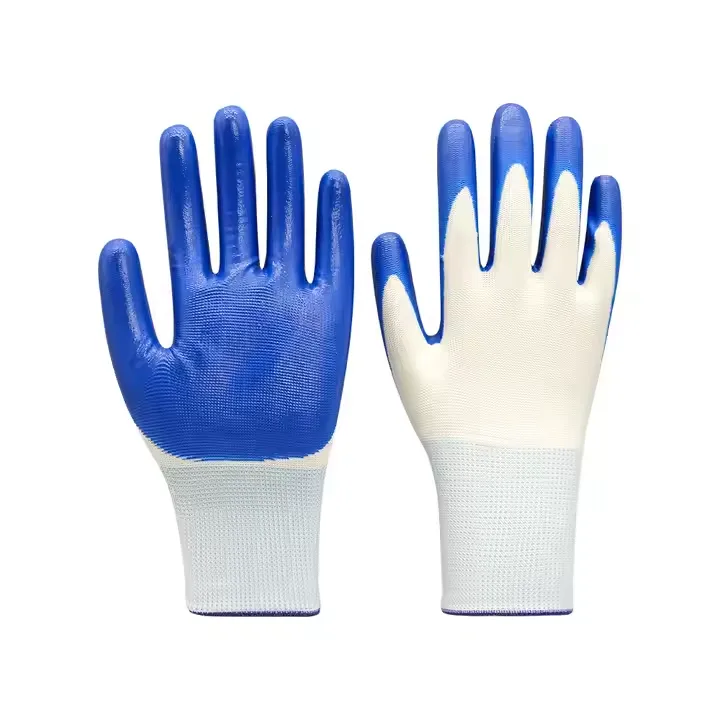
Start with a coverage map, not a marketing label
“Palm-coated” usually signals that coating is concentrated on the gripping face, while the back of the hand is largely uncovered. “Three-quarter” generally means that coating extends farther around the fingers and hand. “Full dip” suggests much more extensive coverage. These phrases are not precise enough for a purchase order on their own. They do not state whether fingertips, finger sidewalls, thumb crotch, cuff edge, or the entire back are coated.
Ask the supplier for front, back, and side photographs of the exact proposed model and a physical reference sample. Mark the coated and uncoated areas on a simple line drawing if the boundary is important. Specify whether the coating should stop at a consistent line around every size or whether a defined variation is acceptable. A photograph is useful for orientation; an approved sample and written construction specification remain the control points.
Palm dip: concentrate on the grip face
A palm-dip design leaves more of the back and sides of the liner exposed than broader-coverage versions. Buyers often consider it when they want contact on the palm and fingers but also want to evaluate flexibility and the feel of an open back. Do not assume that an open back guarantees breathability in a particular task; liner material, coating formulation, garment fit, working temperature, and wear conditions all matter.
Inspect the thumb crotch and the ends of the fingers closely. Some products have coating that wraps around those areas; others leave a larger exposed zone. Those differences may be more relevant than the headline label. For a repeatable purchase, record where the coating terminates on the thumb and each finger.
Three-quarter dip: define the boundary
Three-quarter coverage is commonly discussed as a middle option, but the term does not specify one universally identical pattern. A supplier may mean coverage over the palm, fingertips, and much of the back, while another may describe a different boundary. The name should therefore trigger a request for drawings and samples, not end the specification conversation.
Check the sidewalls of the fingers, the knuckle area, and the transition line around the back. Ask whether the coating process creates a visibly uneven edge and how that edge is judged during inspection. If the buyer expects a particular area to remain exposed for comfort or identification, write that expectation into the approved sample record.
Full dip: avoid assuming complete protection
A full-dip description indicates broad coating coverage, but it is not proof of liquid-tightness, chemical resistance, or any other specific protective performance. Construction details such as the cuff, seams or openings, coating continuity, and test scope still have to be assessed for the intended task. A glove described as fully dipped should not be treated as a substitute for a model-specific hazard assessment or relevant documentation.
Check whether the entire cuff is coated or only the hand portion. Inspect finger crotches and coating transitions under consistent light. If the application involves liquid exposure, ask for evidence addressing the actual exposure and the exact glove model instead of inferring suitability from visual coverage alone.
Compare the whole glove, not just the dipped area
Coverage is one design variable among several. A wider coating area can change weight and hand feel, while liner yarn, knit gauge, coating texture, and size can also change the wearer’s experience. A comparison trial is only useful when the buyer knows which variables are being held constant. If one sample changes both coating coverage and liner construction, a preference result cannot be attributed to coverage alone.
Build a comparison sheet with one row per sample and record:
- Supplier model code and buyer SKU.
- Liner fiber, knit gauge, size, and cuff construction.
- Coating material, texture, number of layers, and coverage drawing.
- Photos of palm, back, fingertips, finger sides, thumb crotch, and cuff.
- Approved sample date and specification revision.
- Task observations for grip, movement, fit, wear, and ease of removal.
- Documents supporting any performance claim made for that exact model.
A buyer should avoid comparing a palm-dipped foam coating against a fully dipped smooth coating and then claiming the coverage alone caused the difference. The product catalog can help shortlist constructions, but an RFQ should identify the exact model and the variables to compare.
Run a short task-based sample trial
Give users a realistic, controlled task rather than asking whether a glove merely feels “good.” Record the objects handled, surface condition, duration, required finger movements, and relevant environmental factors. Observe whether users can pick up parts, manipulate tools, and remove the glove without unusual difficulty. Repeat the trial across proposed sizes; a coverage boundary can appear different on a small and a large glove.
Keep subjective comfort notes separate from protection evidence. A glove may be preferred for dexterity yet fail another selection requirement. Likewise, broader coating may look reassuring but still lack evidence for a claimed hazard. Supervisors and procurement teams should evaluate each criterion against the site’s hazard assessment and applicable destination-market requirements.
Questions worth asking during the trial
- Does the coating contact the actual objects and surfaces the worker handles?
- Do the fingertips and thumb crotch retain the movement needed for the task?
- Is the exposed liner likely to contact anything the buyer intended it to avoid?
- Can workers distinguish this model from similar-looking stock by label and SKU?
- Do sample observations agree with the written construction specification?
Write down both positive and negative findings. A short trial report with dated sample IDs is more useful for reorders than an undocumented choice between “palm” and “full.”
Turn coverage into a production-ready specification
Once a construction is selected, use an approved sample as the physical reference and define what may change without renewed approval. The purchase specification should name the liner, coating, texture, coverage boundary, sizes, markings, packaging, and supporting document set. Where appearance matters, describe acceptable variation in practical terms that both parties can inspect. Do not invent a numeric tolerance simply because it looks precise.
Include a front-and-back image or drawing on the purchase-order annex. Specify whether coating overflow onto the back, uncovered patches on the palm, or inconsistent finger coverage are rejectable. Agree on a sampling and inspection approach before production. The work glove change-control guide explains why material, process, and artwork changes should be communicated before a repeat order is made.
For private-label ranges, carry the coverage description into product records and carton labels. A model code should remain the primary identifier even when two styles are visibly different. If the same color is used for several coverage patterns, make the buyer SKU and product name unambiguous so a warehouse cannot substitute one for another by appearance.
Check documents and claims against the exact model
Coverage alone cannot establish a standard rating. If a quotation, catalog page, or carton claims cut, abrasion, chemical, or other protection, request the current model-specific test report or declaration that supports the claim for the target market. Check that the product code, construction, and size range in the documents correspond to the offered glove. If the coating pattern changes, ask whether the existing evidence still applies rather than assuming that it does.
Separate product selection from marketing language. Phrases such as “oil resistant,” “waterproof,” or “chemical resistant” may be interpreted differently by buyers unless the intended exposure and supporting evidence are specified. For claims that matter to worker safety, ask what was tested, by whom, under which method, and for which exact model. Do not infer a result from a photograph or from another glove in the range.
Receiving and reorder checklist
Before releasing a bulk shipment into stock, receiving staff should compare the actual glove with the approved sample and purchase-order annex. A quick visual check of the coating edge on several sizes can reveal a pattern mismatch. Also check model labels, size markings, inner packs, cartons, and lot identifiers. The lot traceability checklist describes how to retain those records for later questions or complaints.
- Confirm buyer SKU, supplier model, size, and specification revision.
- Compare coating boundaries at fingertips, thumb crotch, finger sides, back, and cuff.
- Record visible gaps, overflow, peeling, or unusually uneven transitions.
- Check labeling and packaging against the approved version.
- Retain photographs and sample references by lot.
- Quarantine and investigate a mismatch before distributing stock.
On a repeat order, ask the supplier to reconfirm the approved construction and identify any proposed change. Do not let “same as last time” replace a model number, specification revision, and sample reference. If a coating-coverage change is intentional, assign a new revision or SKU and update the user trial and documentation as needed.
Conclusion: buy the boundary you actually need
Palm, three-quarter, and full dip are useful starting terms, but a sound B2B purchase decision requires more detail. Map the coated area, compare matched samples in the real task, document the approved construction, and validate every protective claim for the exact model. Those steps make orders easier to inspect and reorders easier to control.
If you are comparing coated work glove constructions for a wholesale or OEM program, contact Rilong with the intended task, destination market, proposed sizes, and coverage drawing. Request current specifications and model-specific test documents before approving a final SKU.
