




“Nitrile” appears on many industrial glove listings, but the word alone does not define the hazard a glove can control. A knit work glove with a sandy nitrile palm may be selected for handling and grip, while a chemical-protective glove must be assessed against the actual substance, exposure route and duration. Confusing the two can turn a purchasing shortcut into a workplace risk.
This guide is for importers, distributors and safety teams reviewing coated work gloves. It explains where a palm-coated handling glove fits, when a chemical-protection review is required, and what evidence to request before writing a claim in a catalog or approving a bulk order. It does not certify a particular Rilong model for chemical contact.
Start with the task, not the coating name
A useful purchase brief describes what workers actually touch. Is the task dry carton handling, gripping slightly oily components, wiping a surface, transferring liquid, or immersing a hand? Does exposure affect only the palm, or can liquid reach the fingers, back of the hand and cuff? The answer changes the glove design and documentation required.
The UK Health and Safety Executive (HSE) advises selecting gloves by the substance, other hazards, type and duration of contact, user and task. Its guidance also notes that no glove material protects against every substance indefinitely. The U.S. Occupational Safety and Health Administration (OSHA) similarly recommends asking manufacturers for documentation against the relevant hazard and considering actual duration and physical stresses. Those principles are more reliable than a broad material label.
What a sandy nitrile palm coating describes
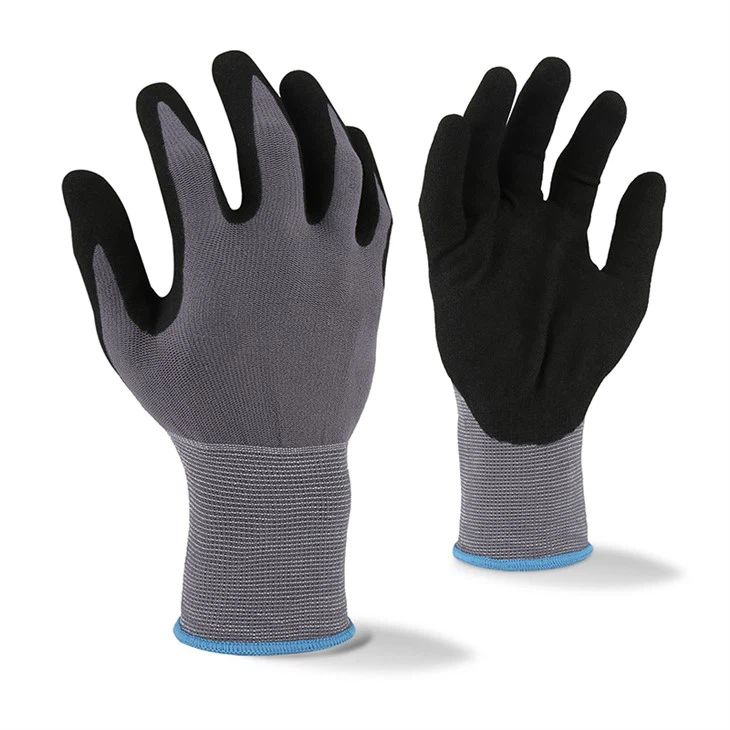
A sandy nitrile palm-coated work glove has a knitted liner and a textured coating over the gripping area. Rilong’s 15-gauge sandy nitrile palm-coated work glove is presented as an industrial handling product. Its short product description tells buyers to confirm the exact liner blend, sizes and coating coverage for the model. That is the right level of detail to carry into an inquiry, rather than assuming every variant is identical.
Coating coverage matters because a palm-coated glove leaves other areas of the knit construction exposed. The coating texture can be evaluated for handling a specified object under a specified condition, but neither texture nor polymer name establishes protection against chemical splashes, vapors or immersion. A picture of the palm is useful for identifying construction; it cannot substitute for a chemical-resistance report.
Do not infer a protection rating from “nitrile”
Nitrile is used in different glove constructions. A reusable chemical glove, a thin disposable glove and a knitted glove with partial nitrile coating are not interchangeable simply because the same material appears in their descriptions. Thickness, continuous coverage, cuff design, seams, exposure time and the particular chemical all matter. Even two gloves made with similar polymers may have different manufacturer data.
A buyer should also distinguish incidental handling of a component with surface residue from deliberate contact with a hazardous liquid. If there is a credible chemical skin-exposure hazard, stop treating the purchase as a grip-only decision and involve the site’s competent safety professional and chemical supplier.
Three chemical failure routes buyers should understand
Permeation
A chemical may move through apparently intact glove material at a molecular level. HSE calls the time until this occurs the breakthrough time. A glove can look normal while exposure is occurring, so a visual check alone cannot establish safe wear time. Ask for data for the named substance and the specific glove, not a generic statement about a polymer.
Penetration
Liquid may pass through pinholes, porous material, seams, openings or uncovered areas. This is an obvious concern when a coating covers only the palm and fingers while the knit back remains exposed. A work glove designed for handling should not be marketed as a liquid barrier unless the complete construction and relevant evidence support that claim.
Degradation
Contact can change the glove material itself: swelling, softening, hardening or loss of strength may make a glove unsuitable. HSE recommends evaluating degradation alongside permeation and breakthrough information. A glove may appear to grip well initially yet perform poorly over the actual exposure period.
When to request a separate chemical-protection specification
Escalate the selection when workers pour, mix, clean with or immerse hands in a hazardous substance; when splashes can reach the back of the hand or wrist; or when repeated contact is expected. The chemical’s safety data sheet and the site risk assessment should identify the substances and exposure conditions. The glove supplier should then provide model-specific compatibility and test information. If the operation involves a mixture, do not assume results for a pure component predict the mixture’s behavior; ask the manufacturer or a qualified safety specialist.
For buyers supplying European markets, protective gloves against dangerous chemicals are addressed by the EN ISO 374 family. However, a standard name in a listing is not proof that a specific model is suitable for a specific chemical or use time. Request the exact report, marking and instructions for the offered model and version. Requirements can differ by destination market and application; the responsible importer or safety team should confirm them before making a compliance claim.
A practical RFQ checklist for coated work gloves
For a handling-glove RFQ, collect the following information in writing so the quote and sample are tied to one unambiguous product:
- Task and environment: Objects handled, surface condition, likely contaminants, temperature and duration of use.
- Xây dựng: Model identifier, liner material, knit gauge, coating material and texture, coating coverage, cuff and proposed sizes.
- Claim boundary: The exact grip or mechanical-protection language proposed for packaging and listings, supported by model-specific documents where required.
- Sample assessment: Fit across the size range, handling control, dexterity, comfort, visible coating uniformity and wear behavior during a controlled field trial.
- Order control: Reference sample, approved specification revision, carton label and procedure for communicating material or construction changes.
If a supplier quotes more than one coverage or liner option, obtain separate identifiers and documents. Do not allow a quotation for a palm-coated variant to be silently fulfilled with another variant, or use one variant’s test report for the entire range. Rilong’s golden sample workflow describes a practical way to keep approved construction aligned with later orders.
A separate checklist for a chemical-exposure task
Where chemical protection is needed, the purchasing file should answer a different set of questions before any approval:
- What are the exact substances or mixture, concentration and temperature?
- Is contact expected to be incidental splash, repeated splash or immersion? Which parts of the hand and forearm may be exposed?
- What wear time is proposed, and what other hazards such as abrasion or cuts coexist?
- Which exact glove model and size are offered, and what are its coverage, thickness, length and cuff design?
- What manufacturer data address permeation, breakthrough, penetration and degradation for the relevant substances?
- What do the instructions say about use limits, replacement, donning, removal and storage?
- Which destination-market documents and markings must the importer verify?
If any answer is missing, record the gap rather than filling it with a marketing assumption. OSHA’s PPE selection guidance specifically points buyers toward manufacturer documentation against anticipated hazards. A site safety assessment remains essential; a blog or product photograph cannot approve a glove for a chemical process.
How to test a handling glove without overstating it
For a coated work glove intended for mechanical handling, design the trial around the real object and movement. Provide samples in representative sizes, define the task and observation period, and record whether the worker can grasp, release and reposition the item reliably. Include fit and dexterity feedback. If the surface has incidental residue, document what that residue is and whether it creates a separate skin-exposure question. Stop the trial if the hazard assessment identifies an unaddressed exposure.
Compare candidate gloves under the same conditions. A structured trial can support a buyer’s preference for handling, but it does not generate a laboratory chemical rating. Keep the trial record, approved sample and final product specification together so purchasing and sales teams do not convert a subjective grip result into an unsupported chemical-protection claim.
Conclusion: keep the claim matched to the evidence
A sandy nitrile palm-coated glove may be a useful handling option, but its construction should be described accurately and evaluated for the specific job. “Nitrile-coated” is not shorthand for chemical resistance. For chemical contact, obtain a separate hazard assessment and model-specific performance evidence before buying, labeling or recommending a glove.
Review Rilong’s 15-gauge sandy nitrile model as a handling-glove starting point, then send the team your task, required construction and destination market for a model-specific discussion. If chemical protection is required, state the substances and exposure conditions explicitly so the appropriate documentation can be assessed.
