








In the vast landscape of Personal Protective Equipment (PPE), the work glove is often seen as the most basic tool. However, this perception belies the incredible complexity and technological innovation engineered into every modern pair. A high-performance work glove is not merely a piece of fabric; it is a sophisticated safety device, born from advancements in material science, ergonomic design, and precision manufacturing. The difference between a standard glove and a technologically advanced one can be the difference between a minor incident and a life-altering injury. In workplaces around the globe, preventable hand injuries remain a leading cause of lost workdays, reduced productivity, and significant financial and personal costs. This underscores a critical truth: understanding the science behind your safety equipment is the first step toward building a truly effective safety culture.
This guide will take you deep inside the world of work glove technology. We will dissect the anatomy of a modern glove, from its core liner to its task-specific coating. We will walk through the intricate manufacturing process that transforms raw fibers and polymers into certified safety equipment. And we will provide a clear, practical breakdown of the international standards that guarantee a glove’s performance. Since 2005, Shandong Rilong Labor Products Co., Ltd. has been at the forefront of this evolution. As a leading manufacturer for over 200 global partners, our mission is rooted in innovation, quality, and an unwavering commitment to worker safety. Our products are not just made; they are engineered and rigorously tested to meet critical standards like CE, EN388, and EN420, ensuring every pair delivers protection you can trust.
The Anatomy of a Modern Work Glove: More Than Meets the Eye
To truly appreciate the functionality of a work glove, one must understand its core components. A typical coated, seamless glove consists of two primary elements: the liner, which provides the foundational structure and primary protection, and the coating, which serves as the direct interface for grip and specialized resistance.
The Liner: The Core of Protection and Comfort
The liner is the knitted shell that your hand fits into. Its construction dictates the glove’s core characteristics, including dexterity, breathability, and its primary level of mechanical protection.
- Seamless Knitting Technology: Modern work gloves are predominantly made using advanced seamless knitting machines. The “gauge” of the knit refers to the number of needles per inch.
- A lower gauge (e.g., 7 or 10 gauge) results in a thicker, heavier knit, offering more cushioning and durability but less dexterity.
- A higher gauge (e.g., 13, 15, or 18 gauge) produces a thinner, more form-fitting liner. An 18-gauge glove, for instance, fits like a second skin, offering maximum dexterity and tactile sensitivity for intricate tasks.
- Liner Materials – A Spectrum of Performance:
- General-Purpose Fibers: Cotton offers breathability and absorption, making it a comfortable choice for light-duty work. Nylon and polyester are synthetic alternatives that provide higher abrasion resistance, dry faster, and produce less lint, making them suitable for cleaner environments.
- Cut-Resistant Fibers: This is where material science truly shines. To protect against sharp edges, liners are engineered with high-performance yarns. These are not simply thick; they are inherently strong. Anti-cut gloves utilize materials like High-Performance Polyethylene (HPPE), which consists of fibers with an incredibly high tensile strength that resist being severed by a blade. For even greater protection, HPPE is often blended with fiberglass or steel fibers, creating a composite yarn that offers exceptional cut resistance as defined by standards like EN388.
- Specialty Fibers: For specific environments, specialized yarns are used. In electronics manufacturing, for example, a small electrostatic discharge (ESD) can destroy sensitive components. Anti-static gloves are made with liners that incorporate a conductive carbon fiber filament. This filament safely dissipates static electricity from the worker’s body, protecting the product being handled.
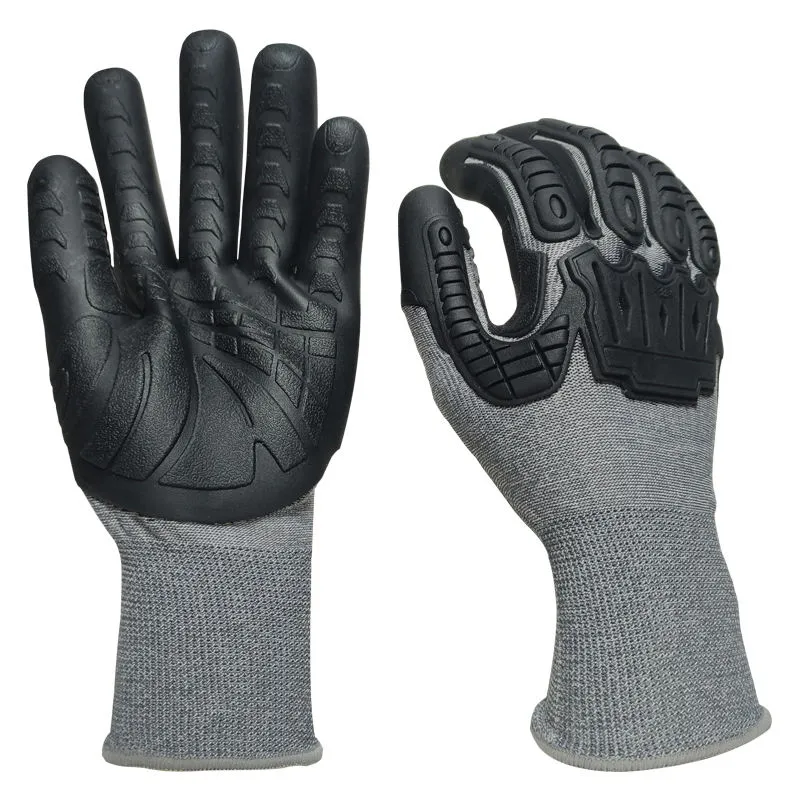
The Coating: The Interface with the Work Environment
The coating is the polymer layer applied to the liner. It enhances grip, adds puncture and abrasion resistance, and provides a barrier against liquids and chemicals. The choice of material and finish is critical for a glove’s performance in a specific application.
- Coating Styles:
- Palm Coated: The most common style, covering the palm and fingers. It provides excellent grip and protection while leaving the back of the hand uncoated for maximum breathability.
- Fully Coated: The entire glove is coated, creating a liquid-resistant barrier ideal for wet or oily environments. This style offers more comprehensive protection but is less breathable.
- ¾ Coated: Offers a compromise, with the coating extending over the knuckles to provide extra protection against scrapes while leaving the upper back of the hand open.
- Coating Material Science:
- Latex: Known for its superb elasticity and grip, especially in dry conditions. A “crinkle” finish is often applied to latex-coated gloves, creating a textured surface that channels away water for a secure grip in wet environments. While cost-effective, its main drawback is the potential for allergic reactions.
- Nitrile: A highly versatile synthetic rubber. It offers superior resistance to punctures, cuts, oils, and a broad range of chemicals compared to latex. The innovation in nitrile coatings is in the finish:
- Smooth Nitrile: Provides a liquid-proof barrier and good grip in dry conditions.
- Foam Nitrile: The nitrile is infused with tiny air bubbles, creating a sponge-like texture. This finish absorbs oils from surfaces, providing an excellent grip in light oil applications.
- Micro-Foam Nitrile: A more advanced version of foam nitrile with smaller bubbles, offering enhanced durability and an even better grip.
- Sandy Nitrile: The coating has a rough, granular texture that acts like sandpaper, creating exceptional friction for an unbeatable grip in wet and oily conditions. You can find this finish on many of our nitrile-coated gloves.
- Polyurethane (PU): PU is the champion of dexterity and tactile sensitivity. It provides a very thin, non-sticky coating with a great grip on dry and slightly oily parts. Because it doesn’t shed particles, PU-coated gloves are the top choice for assembling electronics, handling small parts, and other precision tasks.
- PVC (Polyvinyl Chloride): A durable and cost-effective coating that stands up extremely well to adhesives, acids, and bases. PVC-coated gloves are a workhorse in industries involving chemical handling and heavy abrasion, though they can be less flexible than other polymers, especially in cold weather.
From Raw Materials to Certified Safety: A Look Inside Rilong’s Manufacturing Process
Creating a high-quality work glove is a multi-stage process that combines automation with skilled oversight. As a full-service OEM & ODM work glove factory, we provide our partners with a transparent and collaborative manufacturing journey.
- Design and Prototyping (The OEM/ODM Advantage): It all begins with understanding the client’s needs. Is the glove for an automotive assembly line dealing with oily metal parts? Or for construction workers handling abrasive blocks in the winter? We consult with our clients to determine the precise performance requirements. This includes selecting the right liner gauge and material, the ideal coating polymer and finish, and customizing features like color, branding, and packaging to create a unique product for their market.
- Automated Liner Knitting: Huge circular knitting machines, programmed with specific sizes and yarn compositions, work tirelessly to produce seamless liners. Hundreds of needles move in perfect harmony to weave the base of the glove. At this stage, quality control is crucial; liners are inspected for any defects, ensuring a consistent and comfortable foundation for every glove.
- The Dipping Line: The knitted liners are then loaded onto ceramic hand-formers and begin a journey along a long, automated dipping line. They are first washed to remove any impurities. Then, they are dipped into a coagulant before being precisely lowered into a tank of liquefied polymer (latex, nitrile, PU, etc.). The duration and angle of the dip determine the coating thickness and style. For finishes like sandy nitrile, a secondary process introduces the textured particles before the final cure.
- Curing, Finishing, and Inspection: After dipping, the gloves pass through long ovens where the polymer is cured, or vulcanized, at a specific temperature. This process cross-links the polymer molecules, giving the coating its strength, elasticity, and durability. Once cured and cooled, the gloves are stripped from the formers. Final steps include printing logos, adding cuff details, and, most importantly, a final round of rigorous visual and physical inspection. Every glove must meet our high standards before it can be packaged.
- Rigorous Quality Assurance and Certification: Throughout the process, and on finished batches, we conduct in-house testing that simulates the EN388 standards. We test for abrasion, cut, tear, and puncture resistance to ensure that the final product not only meets but often exceeds the required safety ratings. This unwavering commitment to quality is how we guarantee that every glove shipped from our facility provides certified, reliable protection.
Decoding the Language of Safety: A Practical Guide to Glove Standards
To choose the right glove, you must be able to understand the safety ratings printed on it. These are not arbitrary numbers but a standardized language that communicates a glove’s performance against specific hazards. The most important standard for general work gloves is EN 388.
EN 388:2016 – The Standard for Mechanical Risks
The EN 388 standard, updated in 2016, provides a comprehensive rating of a glove’s ability to withstand mechanical hazards. The rating is represented by a pictogram of a hammer, followed by a series of numbers and letters.
- 1. Abrasion Resistance (Rated 1-4): This tests how many cycles it takes for an abrasive paper to wear a hole through the glove’s palm material. A rating of 4 indicates high durability for handling rough materials.
- 2. Circular Blade Cut Resistance (Coup Test, Rated 1-5): A circular blade moves back and forth across the glove material under a fixed load. The rating is based on how many cycles it takes to cut through. However, this test can be less accurate for high-performance fibers, which can dull the blade and skew the results. This led to the addition of a new test.
- 3. Tear Resistance (Rated 1-4): This measures the force required to tear the glove material. A high tear resistance is important for durability and preventing a small snag from becoming a large hole.
- 4. Puncture Resistance (Rated 1-4): This measures the force needed for a standard-sized point to pierce the material. This should not be confused with resistance to fine needles.
- 5. ISO 13997 (TDM-100 Test) Cut Resistance (Rated A-F): This is the most accurate test for cut resistance. A straight blade is drawn across the material one time under increasing force. The rating (A through F) corresponds to the force in Newtons required to cut through the material at a distance of 20mm. An ‘F’ rating represents the highest level of cut protection, essential for those working with extremely sharp blades. Our Level 5 (or Level F) cut-resistant gloves are certified under this rigorous standard.
- 6. Impact Protection (Rated P): If the glove includes impact protection (like TPR on the back of the hand), and it passes the standard’s test for force dissipation, it receives a “P” marking. Our impact protection gloves are designed to meet this critical requirement for heavy industry.
Other Key Safety Standards
- EN 420: This standard covers general requirements for all protective gloves, ensuring they are constructed properly, are comfortable, fit correctly (sizing), and that the materials are not harmful to the user.
- EN 511: Protection Against Cold: For winter gloves, this standard rates performance against convective cold, contact cold, and water permeability.
- EN 407: Protection Against Thermal Risks: Crucial for welding gloves and heat-resistant PPE, this standard tests for flammability, contact heat, convective heat, and molten metal splash.
Advanced Applications: Choosing the Right Glove for High-Stakes Industries
Applying this technological and standards knowledge is key to selecting the right protection for specific industrial environments.
- Construction & Demolition: This industry demands durability above all. Workers need protection from abrasion from concrete blocks, punctures from nails and rebar, and impacts from tools.
- Recommendations: Heavy-duty work gloves with a high abrasion rating (EN388 Level 4), such as sandy nitrile coated or crinkle latex coated gloves. For demolition and heavy machinery operation, impact work gloves with TPR protection are essential.
- Automotive & Mechanics: This work involves a combination of dexterity for small parts, a secure grip in the presence of oils and lubricants, and protection from sharp metal edges.
- Recommendations: Nitrile foam or micro-foam coated gloves are perfect as they absorb oils to maintain grip. A thin, 15 or 18-gauge mechanic glove with a good cut rating (Level C/A3 or higher) provides an excellent balance of protection and dexterity. Our specialized oil-resistant gloves are engineered for these exact conditions.
- Electronics & Precision Assembly: The primary concerns here are preventing product contamination from hand oils and avoiding electrostatic discharge (ESD).
- Recommendations: Lint-free nylon liners with a thin PU coating on the fingertips or palm provide the necessary tactile feel. For ESD-sensitive areas, gloves with carbon fiber filaments are mandatory.
- Welding & Metal Fabrication: Workers face extreme heat, sparks, and constant handling of sharp, abrasive metal sheets. Protection must be robust and comprehensive.
- Recommendations: Thick, durable leather welding gloves made from cowhide with Kevlar stitching and a long cuff are the standard for MIG and Stick welding. For fabrication and parts handling, a seamless knit glove with a high cut rating (Level D/A4 or higher) is required.
- Agriculture & Gardening: This involves a mix of hazards, including abrasion from soil and tools, punctures from thorns, and exposure to moisture and chemicals.
- Recommendations: A general-purpose garden glove with a latex or nitrile coating offers great protection for most tasks. For heavy-duty work like clearing brush or handling thorny plants, a more robust leather or PVC-coated glove is advisable.
The Rilong Partnership: More Than a Product, A Safety Solution
In a global market filled with options, choosing a supplier is a critical business decision. A partnership with Shandong Rilong offers more than just a catalog of products; it provides a comprehensive safety solution built on nearly two decades of industry leadership.
- Expert Consultation and Customization: We don’t just sell gloves; we solve problems. Our team works closely with clients to analyze their specific workplace hazards and market needs. This consultative approach allows us to leverage our deep knowledge of materials and technology to recommend or design the perfect glove, fully customized through our OEM & ODM services.
- Reliability Through Scale and Quality: Our state-of-the-art manufacturing facility is the backbone of our reliability. With a large production capacity, we can meet the most demanding wholesale orders efficiently and on time. This scale is matched by an uncompromising dedication to quality control at every step, ensuring that every shipment meets the same high standards our 200+ global partners have come to expect.
- A Commitment to Innovation and Safety: Our vision extends beyond being a leading manufacturer; we aim to be a leader in advancing worker safety. This means we are constantly researching new materials, refining our manufacturing processes, and developing innovative designs that offer better protection, greater comfort, and superior performance. Our mission is simple: to protect the hands of workers across the globe with reliable, high-quality safety solutions.
The modern work glove is a testament to what is possible when technology, material science, and a commitment to human safety converge. By understanding the intricate details of its construction and the rigorous standards that govern its performance, you can make more informed decisions to protect your workforce. Choosing the right glove is the first step. Choosing the right partner to provide it is what ensures long-term safety and success. We invite you to explore our comprehensive range of safety gloves and discover how a partnership with Rilong can elevate the safety and productivity of your operations.
