





The industrial world stands on the precipice of a fourth revolution. Industry 4.0 has already transformed manufacturing floors with automation, machine learning, and interconnectivity. Now, this digital transformation is extending to the worker themselves. The concept of the “Connected Worker” is reshaping how we view personal safety, moving from a reactive model—where Personal Protective Equipment (PPE) serves as a last line of defense against injury—to a proactive, data-driven ecosystem. At the forefront of this shift is the evolution of the work glove. No longer just a passive textile barrier, the next generation of hand protection is being reimagined as an intelligent node in the Industrial Internet of Things (IIoT). “Smart Gloves,” equipped with sensors, conductive fibers, and communication modules, promise to make the invisible visible: detecting toxic exposure, monitoring vibration limits, and tracking compliance in real-time. This comprehensive report explores the technological frontier of hand protection. We will delve into the convergence of textiles and electronics, the potential of data analytics to predict and prevent injuries, and the manufacturing innovations that are bridging the gap between today’s high-performance gloves and the smart wearables of tomorrow.
Section 1: The Paradigm Shift – From Passive to Active Safety
To understand the magnitude of this shift, one must contrast it with the current state of the industry. Traditional high-quality gloves, such as Level 5 anti-cut gloves or heavy-duty leather welders, are “passive.” They sit dormant until a hazard—a blade, a spark, or a rough surface—strikes them. Their effectiveness is binary: they either stop the injury, or they fail.
“Active” safety, facilitated by smart technology, changes the equation. An active glove interacts with the environment and the user. It can warn a worker that a chemical is present before it permeates the glove. It can alert a supervisor that a worker has removed their gloves in a high-risk zone. It can track the cumulative vibration dose from a jackhammer and signal when a safety threshold is reached. This shift moves safety management from “incident reporting” to “incident prediction.”
Section 2: The Enabling Technologies – Conductive Yarns and Micro-Sensors
The realization of smart hand protection relies on the successful integration of three key technologies: conductive textiles, miniaturized sensors, and low-power wireless communication.
1. Conductive Textiles and E-Textiles
The foundation of a smart glove is the ability to transmit data through the fabric itself. This technology has its roots in the anti-static gloves used in electronics manufacturing. These gloves already utilize carbon or copper filaments woven into the nylon or polyester liner to dissipate static electricity.
In smart gloves, this concept is advanced significantly. Highly conductive yarns are knitted directly into the seamless liner, turning the glove into a flexible circuit board. These pathways can connect fingertip sensors to a wrist-mounted battery and transmitter unit, all without compromising the dexterity or comfort of the glove.
2. Embedded Sensors
What can a glove detect? The possibilities are defined by the sensors embedded within the polymer coating or the liner.
- Pressure and Force Sensors: Piezoelectric sensors can measure grip force. This data is invaluable for ergonomics, helping to identify tasks that require excessive exertion and redesigning them to prevent musculoskeletal disorders.
- Chemical Sensors: Advanced polymers are being developed that change electrical resistance when exposed to specific volatile organic compounds (VOCs) or acids. This could provide an immediate alert to a worker handling hazardous materials, far superior to the visual inspection of a standard chemical rubber glove.
- Vibration Sensors (Accelerometers): Hand-Arm Vibration Syndrome (HAVS) is a permanent, debilitating condition. While anti-vibration gloves dampen the energy, smart gloves with accelerometers can measure the exact dosage of vibration a worker receives, ensuring they stay within ISO 5349 safety limits.
- NFC and RFID Tags: Near Field Communication (NFC) chips embedded in the cuff allow for digital inventory management. A worker can scan their gloves at a vending machine or workstation to verify they have the correct PPE for the specific task at hand.
Section 3: The Data Revolution – Predictive Analytics in Safety
The true power of smart PPE lies not in the hardware, but in the data it generates. When thousands of workers are wearing connected gloves, safety managers gain access to a “God’s eye view” of the facility’s safety health.
Near-Miss Detection
Currently, near-misses are vastly underreported. A worker drops a heavy wrench, it bounces off their steel-toed boot, and they pick it up and keep working. No report is filed. With smart gloves equipped with impact sensors (similar to the concept of impact work gloves but digital), that event is recorded as a high-G force anomaly. Safety managers can aggregate this data to identify “hot spots” in the facility where dropped objects are frequent, allowing them to intervene with training or process changes before a real injury occurs.
Compliance Monitoring
One of the hardest things to enforce is compliance. Are workers actually wearing their gloves? Smart gloves can utilize capacitive sensing to detect the presence of the human hand. If a machine guard is triggered while the worker is not wearing their gloves, the system could log the non-compliance or even prevent the machine from starting. This ensures that the protection provided by high-performance gear, like anti-cut work gloves, is actually being utilized.
Section 4: The Bridge to the Future – Current High-Tech Innovations
While fully digitized, sensor-laden gloves are still in the early adoption or prototype phase for many industries, the bridge to this future is being built today through advanced material engineering. The “intelligence” in current gloves lies in their advanced polymer chemistry and precision manufacturing.
Touchscreen Compatibility: The First Step to Connectivity
The most ubiquitous “smart” feature available today is touchscreen compatibility. As tablets and HMIs (Human-Machine Interfaces) become standard on the factory floor, workers cannot afford to remove their gloves.
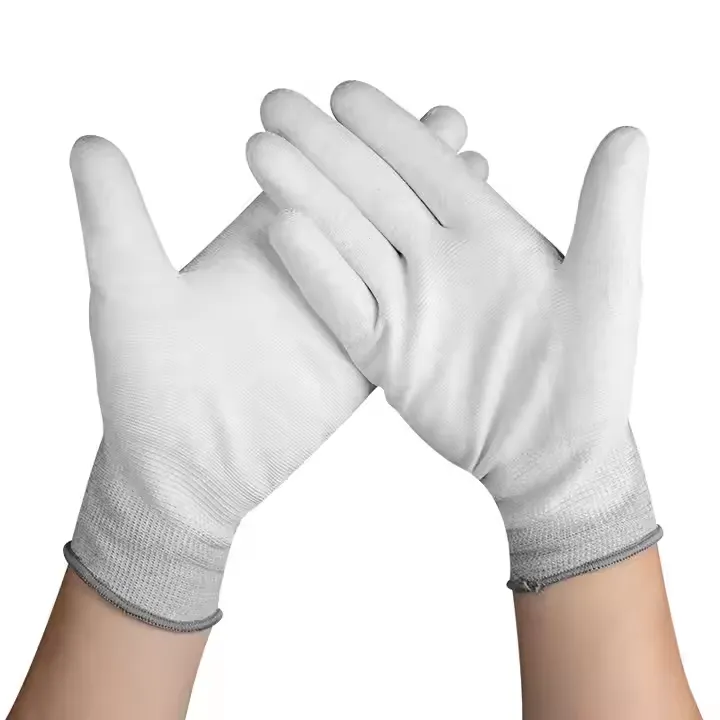
Manufacturers are integrating conductive fibers into the fingertips of PU coated gloves and nitrile gloves. This allows the capacitive charge from the finger to pass through the dielectric coating, enabling interaction with screens. This is a critical safety feature; removing a glove to swipe a screen leaves the hand vulnerable. Keeping the glove on maintains the safety barrier.
Engineered Impact Dissipation
Before digital sensors monitor impact, mechanical engineering must manage it. The evolution of Thermoplastic Rubber (TPR) exoskeletons on TPR impact mechanic gloves represents a sophisticated, non-digital “smart” response. These pads are segmented to move with the hand but lock together upon impact to disperse energy. This passive intelligence is the physical precursor to the digital monitoring of the future.
Advanced Knitting Technologies
The chassis for future smart gloves is the seamless knit liner. Today’s manufacturing capability to produce 18-gauge and 21-gauge liners—extremely thin, tight knits found in premium polyester PU gloves—provides the necessary platform to weave in micro-sensors and conductive threads without creating bulk or discomfort.
Section 5: Challenges to Adoption – Durability and Cost
Despite the promise, significant hurdles remain before smart gloves become the industry standard.
The Washability Problem
Industrial gloves get dirty. They are covered in grease, oil, and grime. To be sustainable and cost-effective, they must be washable. However, electronics and water are traditional enemies. Encapsulating sensors and power sources (batteries) in a way that withstands industrial laundering processes is a major engineering challenge currently being tackled by R&D departments.
Cost vs. Benefit Analysis
A smart glove will inevitably cost significantly more than a standard disposable or reusable glove. For a generic application, the ROI may not be there. However, for high-value applications—such as oil rig maintenance, specialized chemical handling, or high-precision aerospace assembly—the cost of a single injury or a quality defect far outweighs the cost of the PPE. The adoption curve will likely begin in these high-risk, high-value sectors before trickling down to general industry.
Section 6: Strategic Preparation for the Future
How should safety directors and procurement managers prepare for this inevitable technological shift?
1. Digitize the Safety Culture Now
Start by embracing data using current tools. Use vending machines to track usage rates of standard items like nitrile mechanics gloves. Analyze injury data to identify patterns. Building a data-driven culture now paves the way for integrating smart PPE data later.
2. Partner with Innovative Manufacturers
Align your supply chain with OEMs who are investing in R&D. Manufacturers like Shandong Rilong, who have mastery over the entire production process from knitting to dipping, are the ones who will successfully integrate these new technologies. Buying from static, low-cost commodity traders leaves you cut off from innovation.
3. Focus on High-Performance Substrates
Transition your workforce to high-performance engineered gloves today. Moving workers from basic cotton to advanced HPPE anti-cut gloves gets them used to wearing form-fitting, technical hand protection. This makes the eventual transition to smart gloves (which will be built on these same high-tech chassis) seamless.
Conclusion: The Intelligent Hand
The future of hand protection is not just about a stronger material or a stickier grip; it is about intelligence. It is about a glove that knows when it is chemically compromised, knows when its wearer is fatigued, and knows when it is protecting a hand from a dangerous impact. The “Connected Worker” is the future of industrial safety, and the smart glove is the critical link in that chain.
While we await the mass adoption of these digital technologies, the path forward is clear: prioritize advanced materials, embrace data-driven risk assessments, and partner with forward-thinking manufacturers. By doing so, businesses can ensure that their safety programs are not just compliant with the standards of today, but are ready for the innovations of tomorrow. Whether utilizing the latest sandy nitrile technology or preparing for sensor-integrated wearables, the goal remains the same: ensuring that every worker returns home with their hands safe, healthy, and ready for another day.
