





In the heavy industrial sectors of construction and mining, the hazards are visceral and immediate: a falling brick, a swinging beam, or a jagged piece of metal. However, in the sanitized, hushed environments of high-tech manufacturing—semiconductor fabrication, aerospace avionics, and medical device assembly—the hazards are often invisible, yet financially catastrophic. Here, the primary threat flows in two directions. The worker needs protection from chemical solvents and repetitive strain, but more critically, the product needs protection from the worker. The human hand is a biological source of salts, oils, and moisture, and, perhaps most dangerously, a capacitor capable of storing and discharging thousands of volts of static electricity. A single, imperceptible spark—an Electrostatic Discharge (ESD)—can vaporize the microscopic circuitry of a microprocessor, turning a high-value component into scrap in nanoseconds. Consequently, the selection of hand protection for these environments is a matter of precise physics and material engineering. This comprehensive report explores the sophisticated world of ESD and precision gloves. We will dissect the science of static electricity, the technology of conductive carbon fibers, the rigorous standards for cleanroom compliance, and the strategic selection of PPE that ensures both yield integrity and worker safety.
Section 1: The Invisible Enemy – Understanding Electrostatic Discharge (ESD)
To appreciate the engineering behind an anti-static glove, one must first understand the enemy it fights. Static electricity is the imbalance of electric charges within or on the surface of a material. It is generated primarily through the triboelectric effect—contact and separation.
The Physics of the Spark
When a worker walks across a floor or slides their hand across a workbench, electrons are transferred, building up a static charge on their body. The human body is a conductor; if isolated from the ground (by rubber-soled shoes or a non-conductive floor), it acts as a capacitor.
Potentials of 3,000 volts are common on the human body; this is the threshold where a person can actually feel a “zap.” However, sensitive electronic components—MOSFETs, laser diodes, and microchips—can be destroyed by discharges as low as 100 volts, or even less. This means a worker can destroy a device without ever feeling the discharge that caused the damage. This “latent failure” is the nightmare of the electronics industry, where a component might pass factory testing but fail weeks later in the consumer’s hands.
The Cost of ESD
The global electronics industry loses billions of dollars annually to ESD damage. This cost is not just in scrapped materials, but in rework labor, warranty claims, and loss of reputation. Therefore, the glove is not just PPE; it is a critical yield-management tool. It serves as the bridge—or the barrier—between the static charge and the sensitive component.
Section 2: The Technology of Conductivity – How ESD Gloves Work
Standard work gloves made of nylon, polyester, or cotton are typically insulators. They hold onto static charge and can generate high fields. To create effective anti-static gloves, manufacturers must fundamentally alter the electrical properties of the textile.
Conductive Fibers: The Carbon Backbone
The core technology involves integrating conductive filaments into the glove’s liner. The most common material used is carbon fiber.
In a carbon fiber nylon ESD glove, thin filaments of carbon are knitted seamlessly with the nylon yarn. You can often see these as faint, dark stripes running through the glove. Carbon is inherently conductive. These fibers create a “low resistance path” across the surface of the glove.
When a worker wears the glove and is properly grounded (usually via a wrist strap or conductive flooring and footwear), any static charge generated on the hand travels instantly through the conductive carbon fibers, away from the fingertips, and to the ground. This prevents the charge from accumulating to dangerous levels.
Copper and Specialized Yarns
For applications requiring even lower resistance (higher conductivity), copper-suffused fibers like Thunderon® may be used. These offer superior performance but at a higher cost. The goal is to achieve a specific range of “Surface Resistivity,” typically between 10^5 and 10^9 ohms per square. This range is the “dissipative” sweet spot: conductive enough to drain charge, but resistive enough to prevent a dangerous shock to the worker if they touch a live voltage.
Section 3: Material Selection – PU, Nitrile, and The “Dip”
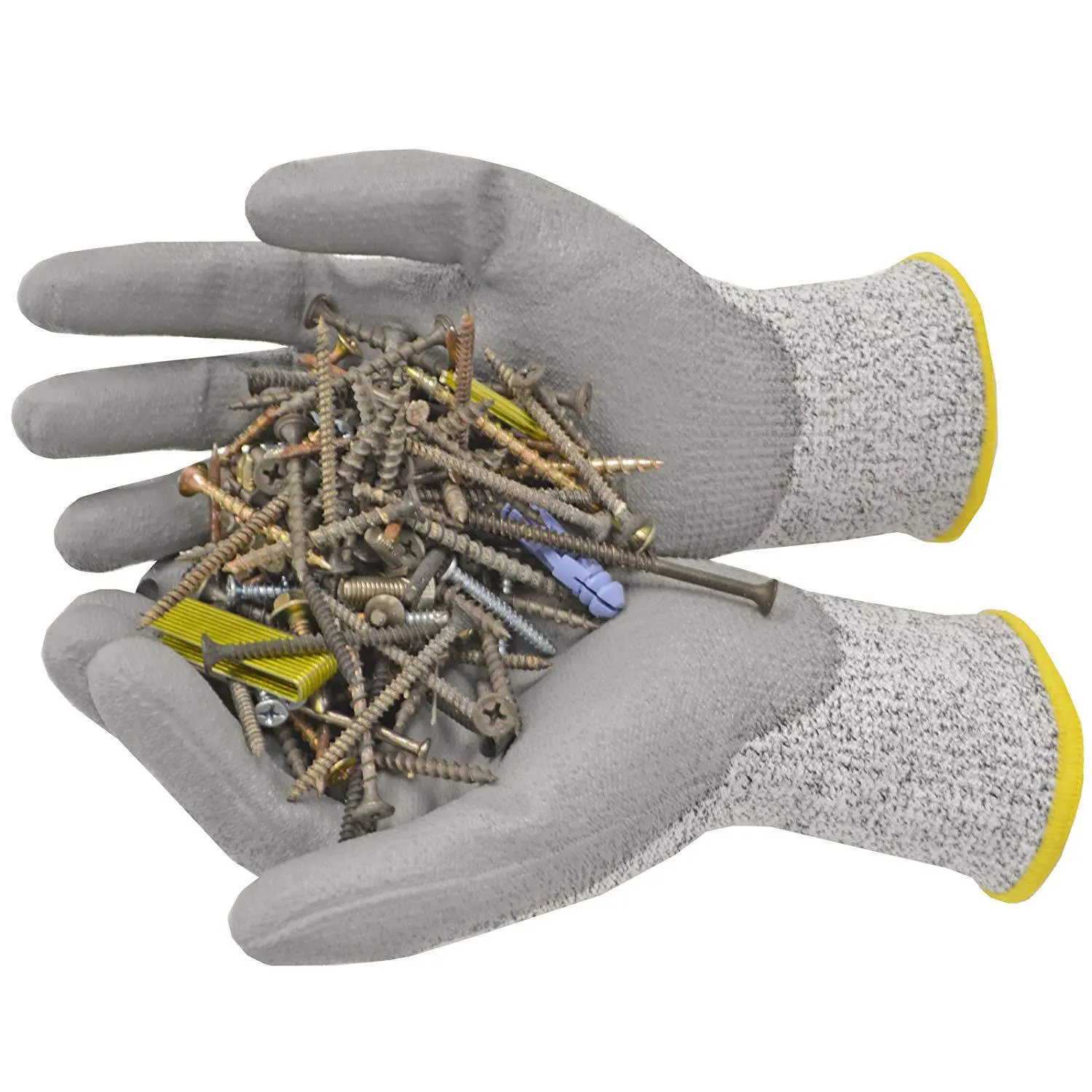
The liner provides the conductivity, but the coating provides the grip and mechanical protection. In high-tech manufacturing, the coating must meet strict criteria: it must be durable, grippy, and above all, non-contaminating (low linting).
Polyurethane (PU): The Industry Standard
Polyurethane is the dominant polymer for electronics assembly gloves. Its popularity stems from several key properties:
- Low Particulate Shedding: Unlike cotton or leather, PU is a continuous film that does not shed dust or fibers. This is critical for keeping optical lenses and circuits clean.
- High Tactile Sensitivity: PU can be applied in an ultra-thin layer. Anti-static PU gloves allow workers to manipulate tiny screws (M1 or M2 size) and feel the “click” of a connector seating properly.
- Non-Sticky Grip: PU has a “dry” tackiness that provides good grip without leaving residue (transfer) on the component.
Nitrile: The Cleanroom Alternative
While PU is excellent, nitrile gloves with anti-static properties are preferred in environments where chemical resistance is also needed, or where there is a concern about PU residues. Nitrile is inherently tougher and more puncture-resistant. High-end cleanroom nitrile gloves are washed in deionized water and packed in vacuum-sealed bags to ensure they are free of ionic contamination (like salt or sodium) which can corrode circuits.
Fingertip vs. Palm Coating
Design variation allows for thermal and ergonomic management:
- Fingertip Coated (Top Fit): Carbon fiber PU fingertips coated ESD gloves have coating only on the very tips of the fingers. This offers maximum breathability and flexibility, ideal for delicate assembly tasks in warm environments where sweaty hands could damage components.
- Palm Coated: Provides better grip and protection for the whole palm, suitable for handling larger chassis or PCBs.
Section 4: Touchscreen Compatibility and the Modern Interface
Modern factories are digitized. Workers interface with tablets, touchscreens, and HMI (Human-Machine Interface) panels constantly. Removing a glove to use a screen is a safety violation and an efficiency killer.
Capacitive Transmission
Standard gloves act as insulators, blocking the capacitive coupling required for a touchscreen to work. However, the same conductive carbon fibers that provide ESD protection also enable touchscreen functionality.
Advanced anti-static gloves for PC building and assembly allow the electrical potential of the user’s finger to bridge through the glove to the screen. This allows for uninterrupted workflow, moving seamlessly from assembling hardware to entering data on a tablet.
Section 5: Contamination Control – Oils, Sweat, and Particulates
ESD is not the only threat. “Foreign Object Debris” (FOD) and biological contamination are major yield killers.
The Threat of Hand Oils
Human skin continuously secretes sebum (oils) and sweat (salts). If a worker touches a bare copper circuit board with a bare finger, the salt will cause corrosion over time, and the oil will prevent solder from adhering properly.
This necessitates the use of a barrier. However, the barrier must not be a source of contamination itself. This is why antistatic gloves undergo leaching processes to remove manufacturing residues. In strictly controlled environments (ISO Class 3-5 cleanrooms), gloves are tested for “Non-Volatile Residue” (NVR) and ion content.
Lint and Dust
In the assembly of camera modules, displays, or sensors, a single fiber of dust is a catastrophic defect. Standard cotton gloves are “particulate generators.” The industry relies on continuous-filament polyester or nylon liners, often described in products like PU finger coated gloves, because these synthetic fibers do not break or shed easily.
Section 6: Standards and Compliance – EN 16350 and ANSI/ESD
Selecting an ESD glove is not a matter of trust; it is a matter of verified compliance. Several standards govern this space.
EN 16350: The European Standard for Protective Gloves – Electrostatic Properties
This is the rigorous standard for gloves used in explosive atmospheres (ATEX) and electronics protection. It requires:
- Vertical Resistance: The resistance through the material must be less than 1.0 x 10^8 ohms (100 megaohms).
- Test Conditions: Testing is done at 25% relative humidity. This is crucial because high humidity makes materials more conductive naturally. Passing at low humidity proves the glove’s intrinsic anti-static properties.
ANSI/ESD SP15.1
The American standard provides test methods for measuring the intrinsic resistance of gloves and finger cots. It focuses on “In-Use Resistance,” ensuring the glove functions as part of a grounded system (worker + glove + wrist strap).
Surface Resistivity vs. Volume Resistance
Buyers must understand the difference. Surface resistivity measures how easily charge moves across the glove’s surface (dissipation). Volume resistance measures how easily charge moves *through* the glove to the wearer’s grounded hand. For effective ESD protection, volume resistance (vertical resistance) is often the more critical metric.
Section 7: Strategic Selection for Different Electronic Sectors
The electronics industry is diverse, and glove selection must be tailored to the specific sub-sector.
1. PCB Assembly (Printed Circuit Boards)
Risk: ESD damage to open components, soldering burns, sharp leads.
Solution: Premium anti-static gloves with a full PU palm coat. The PU protects the palm from sharp solder leads and provides good grip for handling boards, while the carbon liner prevents static buildup.
2. Micro-Assembly and Optics
Risk: Particulates (dust), fingerprints, crushing delicate parts.
Solution: Fingertip-coated ESD gloves. The minimal coating maximizes sensitivity for handling tiny lenses or sensors, and the open back reduces hand sweat (a source of contamination).
3. PC Building and Server Maintenance
Risk: Static discharge to RAM/CPU, sharp case edges.
Solution: Durable black anti-static gloves. These often have a slightly thicker liner for mechanical protection against the sharp metal edges of computer cases, while still maintaining ESD grounding.
4. Final Box Build and Packaging
Risk: Grip, cardboard cuts, general handling.
Solution: Cost-effective general purpose anti-static gloves. Here, the focus is on grip and moderate durability. The anti-static property prevents the packaging materials (Styrofoam, plastic) from sticking to the worker’s hands due to static cling.
Section 8: Care and Maintenance of ESD Gloves
Unlike disposable gloves, ESD knit gloves are reusable, but they are fragile systems.
- Washing: Can you wash ESD gloves? Yes, but with caution. Harsh detergents can damage the conductive carbon fibers or strip the PU coating. They should be washed with non-ionic detergents and air-dried.
- Testing: Over time, the carbon fibers can break due to flexing, breaking the conductive circuit. In critical environments, gloves should be tested periodically on a “Glove Test Fixture” to ensure their resistance remains within the safe range (typically < 10^8 ohms).
- Visual Inspection: Any wear in the fingertips that exposes the skin defeats the contamination control purpose. Any flaking of the coating creates dust. Gloves showing these signs must be replaced immediately.
Conclusion: The Critical Role of the Glove in High-Tech Yields
In the high-tech sector, the margin for error is measured in microns and volts. A comprehensive hand protection program is a vital component of Quality Assurance. By understanding the invisible physics of electrostatics and the material science of conductive polymers, manufacturers can select PPE that actively contributes to higher yields and lower defect rates.
The transition from using generic gloves to specialized ESD-safe hand protection represents a maturation of manufacturing processes. It acknowledges that in the era of micro-electronics, the human touch must be engineered as carefully as the components themselves. Whether sourcing for a massive semiconductor fab or a boutique PC modification shop, the right glove is the final, critical connection between the creator and the creation.
