








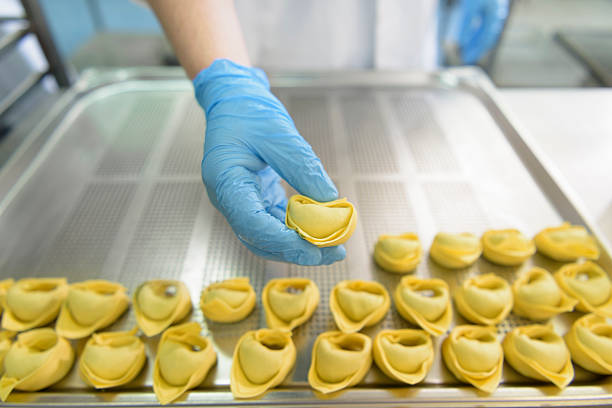
The gloves referenced in this section are produced using food-grade materials and comply with relevant international standards for food contact. They are safe for direct contact with food, non-toxic, and suitable for use in food processing, preparation, and handling environments, ensuring both hygiene and reliable protection.
Why Material Safety Matters in Food-Related Wholesale Glove Procurement
In food-related environments, glove failure has two dimensions. The first is mechanical — a torn glove exposes the worker. The second is chemical — a glove that leaches residual solvents into food creates a contamination risk that is invisible until a recall happens.
Chemical migration is the failure mode most procurement managers underestimate. The assumption that any glove labeled “food-grade” is chemically inert is not reliable. Glove manufacturing involves plasticizers, accelerators, and residual solvents — particularly DMF — introduced during the dipping process. In high-fat or acidic food environments, these substances can transfer from the glove material into the product if manufacturing controls are insufficient.
For wholesale buyers supplying food-related operations, the procurement question is not just “does this glove fit” but “what does this glove leave behind.” Controlling DMF below 10ppm is the measurable threshold that separates chemically safe production from chemically risky production.
Nitrile vs Latex — Choosing the Right Material for Food-Related Environments
When selecting nitrile gloves for food processing, the choice of material is the first decision in your safety strategy. For decades, latex was the default due to its natural elasticity. However, in modern food production, nitrile has become the industry standard for three clear technical reasons:
- Protein Allergy Risk: Latex contains natural proteins that are known allergens. In a food processing environment, even trace amounts of latex protein can trigger allergic reactions in consumers, creating an unacceptable liability profile.
- Chemical Resistance: Nitrile nitrile offers a much more stable barrier against animal fats, vegetable oils, and common cleaning chemicals, whereas latex can degrade or “swell” when exposed to certain oils.
- Puncture Resistance: Nitrile provides a more reliable barrier against the sharp edges of organic materials and processing equipment, maintaining its integrity under the mechanical stress of an 8-hour shift.
At Shandong Rilong, we have aligned our production to favor high-durability nitrile for its superior safety profile. For clients still requiring the specific tactile feel of latex for household or light kitchen tasks, we offer our 2025 hot sell latex household cleaning gloves waterproof gloves, but we always advise nitrile for high-volume commercial food manufacturing.
Chemical Safety Standards — What EN ISO 21420 Means for Food-Contact Gloves
EN ISO 21420 is not a food-specific certification — it is a general glove safety standard covering material harmlessness, including pH values and restricted substance limits. Its relevance to food-related procurement is indirect but meaningful: a glove that meets EN ISO 21420’s chemical safety requirements has passed the same substance restriction criteria that matter most for food contact risk.
The specific parameter to verify is DMF content. DMF is a solvent used in PU and nitrile coating processes. At elevated concentrations, it migrates readily into fatty or oily food contact environments. EN ISO 21420 requires restriction of harmful substances, and our manufacturing process keeps DMF consistently below 10ppm across all coated product lines, verified through third-party laboratory testing.
When evaluating a food-grade nitrile gloves wholesale partner, request the EN ISO 21420 test report for the specific product batch — not a general company certificate. The report should identify the product by model, confirm the testing laboratory’s accreditation, and show actual substance measurements rather than just a pass/fail result.
Key Features to Specify When Sourcing Food-Grade Nitrile Gloves in Bulk
To ensure your bulk procurement meets the demands of a high-speed production environment, specify the following technical features:
- Coating Type: Opt for micro-foam nitrile for high-grip, wet-processing environments where workers need to handle slippery produce. Use smooth, flat-coated nitrile for environments where cleaning and debris removal are the priority.
- Knitting Gauge: Specify 18-gauge liners for fine-motor tasks (e.g., de-boning, precision vegetable prep). The increased dexterity reduces the “fumbling” that causes glove tears.
- Thickness Consistency: Ensure the manufacturer utilizes automated dipping lines. Variation in thickness is where pinholes form.
- Compliance Documentation: Insist on a batch-specific Certificate of Analysis (COA) that highlights solvent levels.
- Color Coding: Always specify non-black colors (e.g., blue or green). In food production, the ability to visually detect an异物 (foreign object) in the food flow is a critical HACCP requirement. Our customized rubber household gloves eco-friendly water proof latex gloves can be color-matched to your specific zone-control requirements.
Bulk Sourcing Considerations — MOQ, Lead Time, and Quality Verification
Efficiency in bulk procurement for food manufacturing plants relies on predictable factory throughput. At Shandong Rilong, we maintain the following parameters to ensure supply chain stability:
- MOQ: 6,000 pairs for new buyers; 12,000 pairs for established wholesale partners.
- Lead Time: 7–25 days from confirmation to dispatch, depending on customization depth.
- Quality Verification: Every shipment includes a detailed EN ISO 21420 test report and a traceability log tied to the production batch number.
To deepen your evaluation of potential manufacturers, we recommend reviewing our household cleaning gloves specifications as a reference point for high-standard hygiene manufacturing. For further guidance on identifying reliable partners, refer to our reusable household cleaning gloves rubber extra thickness long sleeves quality audit criteria previously outlined in our supply chain audit guide.
Procurement FAQ
1. Why is DMF level management so critical for food safety?
DMF is a residual solvent. If the glove material is not thoroughly washed during production, DMF can leach out when the glove comes into contact with fats or oils in food. Keeping DMF levels below 10ppm is the industry’s “Gold Standard” for preventing chemical contamination.
2. Can I use black nitrile gloves in food production?
It is generally discouraged. Most food safety protocols require high-contrast colors (like blue or green) so that any torn glove fragment is immediately visible to the worker or in-line inspection systems. Black gloves effectively “hide” the debris until it is too late.
3. How do I verify a supplier’s claimed EN ISO 21420 compliance?
Request the full technical dossier, specifically the “Harmlessness” section of the EN ISO 21420 test report. Ensure the report is from an accredited lab and bears a recent date. If a supplier refuses to share the full report, they likely lack the chemical-control processes necessary for food-grade safety.
