








In the hierarchy of industrial hand injuries, cuts and lacerations often dominate the conversation. However, a quieter but equally devastating class of injuries plagues heavy industries such as oil and gas, mining, construction, and heavy manufacturing: blunt force trauma and vibration-induced disorders. These injuries do not occur on the tough, fleshy palm of the hand, but on the fragile, exposed dorsal side (the back of the hand). Here, a complex network of tendons, fine blood vessels, and the metacarpal bones sit just beneath a thin layer of skin, with virtually no natural fat or muscle to cushion them from a blow. A dropped wrench, a swinging pipe, or the prolonged use of a jackhammer can cause debilitating damage that sidelines a skilled worker for months. Addressing these risks requires a shift from simple barrier protection to advanced energy management. This guide explores the sophisticated engineering behind impact work gloves and anti-vibration technologies. We will dissect the physics of Thermoplastic Rubber (TPR) armor, explain the rigorous testing of the ANSI/ISEA 138 standard, and examine the critical fight against Hand-Arm Vibration Syndrome (HAVS).
The Anatomy of Vulnerability: Why the Back of the Hand Needs Armor
To understand the necessity of impact protection, one must first understand the biomechanical vulnerability of the human hand. The palm is designed for gripping and enduring pressure; it is padded with muscle and tough skin. The back of the hand, however, is designed for extension and flexibility. The metacarpal bones are relatively thin and are located immediately under the surface. A “struck-by” incident—where an object impacts the hand—transfers kinetic energy directly into these rigid structures.
- Fractures and Contusions: Without dissipation, impact energy can easily fracture the metacarpals or crush the delicate knuckles.
- Soft Tissue Damage: Impacts can severely damage the extensor tendons, limiting finger movement and hand function long after the bones have healed.
- The Solution: The engineering goal of an impact resistant glove is not just to provide a cushion, but to intercept the impact energy and disperse it across a wider surface area, reducing the peak force transferred to any single point on the bone.
The Engine of Protection: Thermoplastic Rubber (TPR) Technology
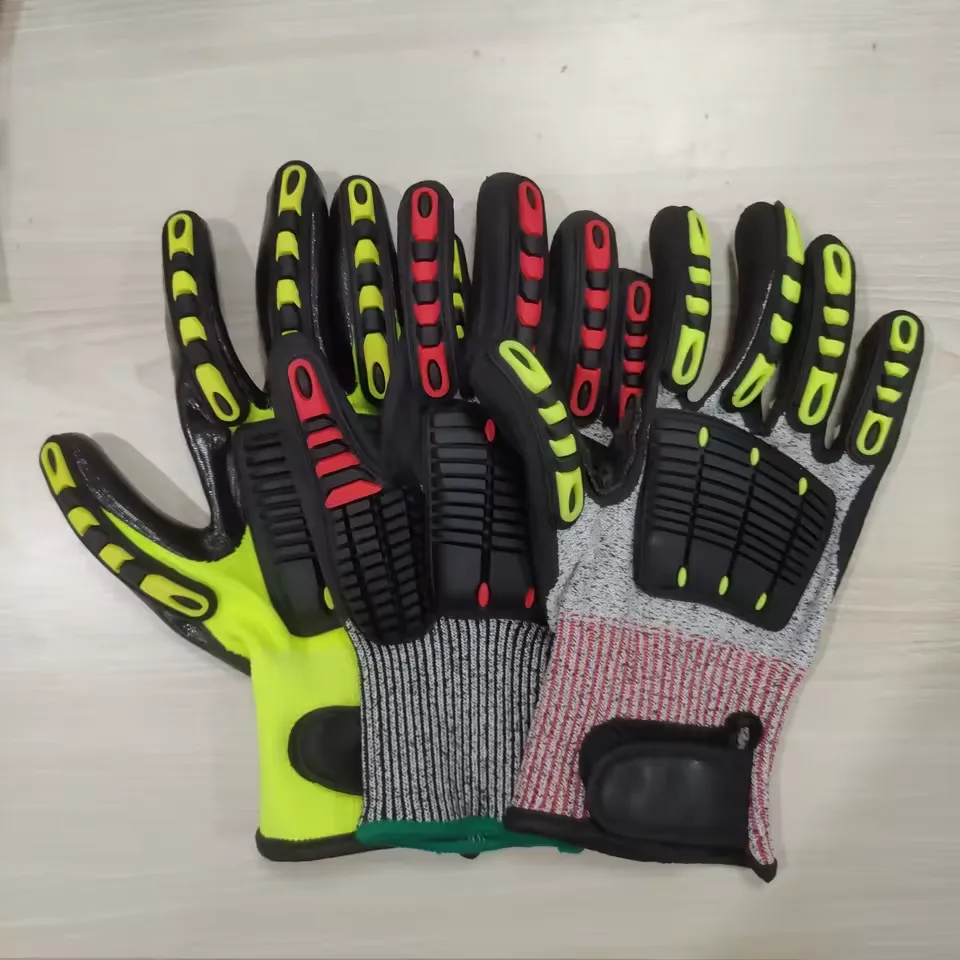
The standard solution for back-of-hand protection has evolved from simple foam pads to advanced, engineered exoskeletons made from Thermoplastic Rubber (TPR). TPR is a polymer that combines the processing properties of plastic with the elasticity and durability of rubber.
How TPR Armor Works
High-quality TPR is molded into specific shapes and sonically welded or stitched onto the glove shell. Its protective mechanism is twofold:
- Absorption: The molecular structure of the TPR material compresses upon impact, absorbing a portion of the kinetic energy much like the crumple zone of a car.
- Dispersion: The shape of the TPR pads is designed to spread the remaining force laterally. Instead of a hammer blow focusing 100% of its energy on a single knuckle, the TPR armor spreads that load over the surrounding soft tissue, significantly lowering the risk of a break.
Ergonomics and Segmentation
A solid block of rubber on the hand would be safe but unusable. The challenge in designing effective TPR impact mechanic gloves lies in segmentation. The armor must be divided into distinct islands or ridges that align perfectly with the hand’s natural flex points. This “segmented exoskeleton” allows the hand to close into a fist without fighting the resistance of the material. Advanced designs often feature “pinch-point” protection that extends to the very tips of the fingers, protecting against common crushing injuries in assembly and rigging tasks.
Quantifying Safety: The ANSI/ISEA 138 Standard
For years, impact protection was an unregulated “wild west,” with manufacturers making vague claims about “bump protection.” This changed with the introduction of the ANSI/ISEA 138 standard, a rigorous testing protocol specifically for back-of-hand impact performance.
The Testing Methodology
The standard uses a drop-mass impact tester. The glove is placed on a steel anvil, and a 2.5 kg weight is dropped onto specific impact points: the knuckles, the fingers, and the thumb. A force transducer underneath measures exactly how much force is transmitted *through* the glove.
The Performance Levels
Based on the amount of force transmitted (measured in kiloNewtons, kN), gloves are assigned a performance level. Lower transmitted force means better protection.
- Level 1 (Low Impact): Transmits ≤ 9 kN of force. Suitable for light construction, warehousing, and confined spaces where bumping hands is a risk.
- Level 2 (Medium Impact): Transmits ≤ 6.5 kN of force. The standard for general construction, heavy mechanics, and extraction industries. A glove like the impact safety glove typically targets this range.
- Level 3 (High Impact): Transmits ≤ 4 kN of force. Designed for the most hazardous environments, such as drilling rigs, demolition, and heavy mining operations. These gloves feature thicker, more substantial TPR armor.
When selecting gloves, safety managers should look for the ANSI/ISEA 138 pictogram marked directly on the glove, ensuring verifiable protection.
The Silent Hazard: Hand-Arm Vibration Syndrome (HAVS)
While impact is an acute event, vibration is a chronic stressor. Workers who operate power tools like jackhammers, chainsaws, grinders, or riveters for prolonged periods are at risk of developing Hand-Arm Vibration Syndrome (HAVS).
Understanding HAVS
Prolonged exposure to vibration damages the capillaries and nerves in the fingers. Early symptoms include tingling and numbness. Over time, this can progress to “Vibration White Finger,” where cold temperatures trigger painful blanching of the fingers and a permanent loss of dexterity and sensation. Once developed, HAVS is irreversible; it can only be prevented.
The Technology of Anti-Vibration Gloves
Standard foam or cloth gloves do little to stop vibration frequencies. True anti-vibration gloves, such as the anti-vibration impact gloves, utilize specialized materials like chloroprene rubber or air-bladder technologies.
- Frequency Dampening: These materials are tuned to dampen specific frequencies of vibration, particularly the harmful lower frequencies generated by heavy tools.
- ISO 10819 Certification: Just as impact gloves have a standard, anti-vibration gloves must meet ISO 10819. This standard measures the glove’s “transmissibility”—its ability to reduce vibration transmission from the tool handle to the palm. Only gloves meeting this standard can be strictly classified as “anti-vibration.”
The Multi-Hazard Approach: Integrating Technologies
In the real world, hazards rarely occur in isolation. A worker on an oil rig faces wet/oily surfaces (slip hazard), sharp metal edges (cut hazard), swinging chains (impact hazard), and vibrating tools. Consequently, the modern market has moved towards multi-hazard gloves.
Combining Cut and Impact Protection
It is now common to see high-performance gloves that combine a cut-resistant liner with an impact-resistant exoskeleton. For example, a cut-resistant TPR glove might feature an HPPE liner for ANSI A4 cut protection, overlaid with Level 2 TPR impact armor. This ensures that if a heavy pipe slips, the worker is protected whether the pipe crushes the hand or slides across it with a sharp edge.
Adding Grip and Chemical Resistance
To further enhance functionality, these complex liners are often dipped in advanced coatings. A sandy nitrile coated impact glove provides the necessary grip to control heavy, oily machinery, which is the first step in preventing an accident. The nitrile coating also adds a layer of liquid and chemical resistance.
Industry-Specific Applications
The application of impact and vibration technology varies by sector.
- Oil and Gas: This is the birthplace of the modern impact glove. The high frequency of heavy, swinging chains and pipes makes dorsal protection mandatory. High-visibility colors are also standard to increase hand awareness.
- Construction and Demolition: Workers here face a mix of impact and vibration risks. Using pneumatic tools requires anti-vibration protection, while handling lumber and stone requires impact protection against crushed fingers.
- Automotive and Heavy Maintenance: Mechanics working in tight engine bays often suffer “knuckle-busting” injuries when wrenches slip. TPR anti-impact working gloves protect against these painful, common injuries, improving mechanic morale and efficiency.
- Mining: The combination of heavy machinery, low light, and rough rock surfaces demands the most robust gloves available, often combining Level 3 impact protection with high abrasion resistance.
Conclusion: A Strategic Investment in Longevity
The adoption of specialized impact and anti-vibration gloves represents a sophisticated understanding of industrial safety. It acknowledges that keeping a worker safe involves more than just preventing open wounds; it involves preserving the long-term structural integrity and neurological health of the hand. While these advanced gloves—engineered with TPR exoskeletons, specialized dampening polymers, and cut-resistant fibers—may carry a higher initial cost than standard cotton or leather gloves, the return on investment is undeniable. By preventing a single metacarpal fracture or saving a skilled worker from the career-ending effects of HAVS, these gloves pay for themselves many times over. For the modern safety manager, selecting the right high-quality impact resistant gloves is a critical step in building a resilient, healthy, and productive workforce.
