





This guide is an exercise in myth-busting. We will systematically identify and deconstruct the most common and dangerous fallacies surrounding safety glove selection. Using the latest data from global safety standards, material science, and ergonomic research, we will replace these myths with a robust, evidence-based framework for decision-making. This article is intended for the conscientious safety professional, the discerning procurement manager, and the operational leader who is committed to building a hand safety program based not on habit, but on a rigorous analysis of performance, value, and human factors. By challenging these deep-seated assumptions, we can elevate the quality of our safety programs, protect our workforce more effectively, and achieve a new level of operational excellence.
Myth #1: “A Higher Cut Level is Always a Better and Safer Glove.”
The Common Logic: This is perhaps the most pervasive myth in hand protection. The logic seems impeccable: if an ANSI A4 cut level is good, then an A7 must be better and an A9 must be the safest possible choice. This leads to a “more is more” procurement strategy, where the highest-rated glove is specified for a wide range of tasks “just to be safe.”
The Data-Driven Reality: Over-protection is a significant and multifaceted risk. While selecting a glove with an adequate cut rating is non-negotiable, choosing one that is excessively over-specified for the task introduces a new set of hazards and inefficiencies.
- The Ergonomic Penalty (Reduced Dexterity): There is an undeniable relationship between cut level and glove construction. Achieving the highest cut levels (ANSI A6-A9) typically requires the use of thicker, heavier composite yarns containing steel or fiberglass. While a marvel of engineering, a glove like this will inherently be thicker and less dextrous than an 18-gauge ANSI A4 glove. For a worker handling small, intricate, or oily parts, this loss of tactile sensitivity can lead to fumbling, dropped items, and a slower work pace. This frustration is a primary driver for a worker to remove their gloves for a “quick” task—the very moment an injury is most likely to occur.
- Increased Hand Fatigue: A thicker, stiffer glove requires more muscle force to flex and grip. Over thousands of repetitions in a single shift, this leads to significant hand fatigue. A fatigued worker is a less attentive and less coordinated worker, increasing their risk of all types of injuries, not just cuts.
- The Financial Inefficiency: High-performance, top-tier cut-resistant gloves are premium products with a corresponding price point. Specifying an ANSI A7 glove for a task that a data-driven risk assessment shows only requires an A3 level of protection can result in a massive and unnecessary inflation of a facility’s PPE budget. This misallocation of funds could be better used on other safety initiatives or engineering controls.
The Correct Approach: Calibrated Protection. The goal is not “maximum protection,” but “optimal protection.” A thorough, task-based risk assessment is the only tool that can determine the appropriate level of protection required. The ANSI/ISEA 105 standard was specifically designed with nine distinct levels to allow for this precise calibration. Match the glove’s rating to the specific hazard—no more, no less.
Myth #2: “All Glove Coatings (Nitrile, Latex, PU) Are Basically the Same.”
The Common Logic: From a distance, a coated glove is a coated glove. The polymer coating is often seen as just a “grip layer,” with little thought given to the profound differences in performance between the various types.
The Data-Driven Reality: The coating is the most critical part of the glove’s interface with the work environment, and each polymer has a unique and distinct performance profile. Choosing the wrong coating for the application is as significant an error as choosing the wrong cut level.
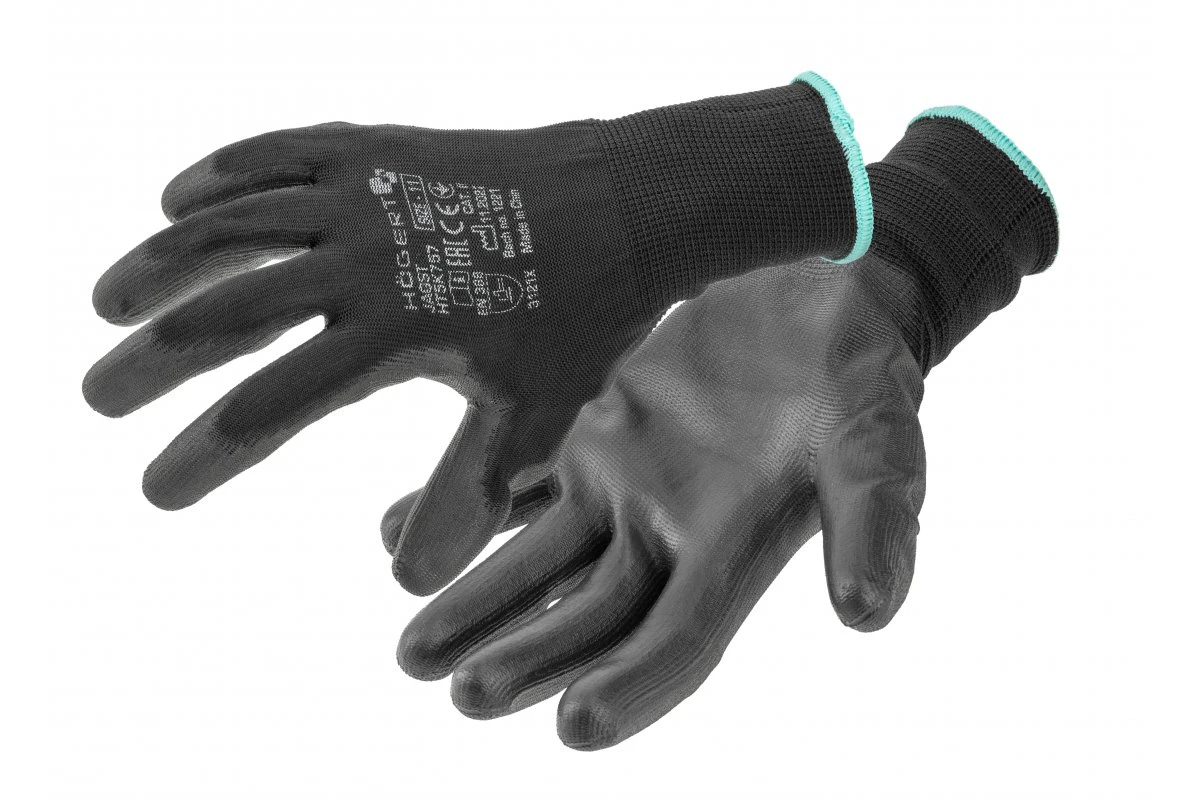
- Polyurethane (PU): The Dexterity Specialist. PU is prized for its ability to provide a very thin, non-sticky coating that offers exceptional tactile sensitivity. It has a high coefficient of friction in dry conditions, providing a superb “dry grip.” However, it is not the ideal choice for heavy oil or wet applications. Best Application: Intricate assembly, electronics, quality inspection where feel is paramount. Our PU coated gloves are engineered for these tasks.
- Latex: The Grip Powerhouse. Natural rubber latex is incredibly elastic and provides a powerful grip, especially when a “crinkle” finish is applied. This finish creates deep ridges that channel water away, making it a top performer in wet conditions. However, it offers poor resistance to petroleum-based oils and carries the risk of latex allergies. Best Application: Construction (handling concrete/wood), glass handling, general material handling in wet/dry environments. Explore our range of latex coated gloves.
- Nitrile: The Versatile Workhorse. Nitrile is the champion of durability and chemical resistance. It stands up to punctures, abrasion, and a wide array of oils, fuels, and solvents. Its versatility is enhanced by its various finishes:
- Foam/Micro-Foam Nitrile: This is a revolutionary technology. The foam structure acts like a sponge, absorbing oils and liquids to provide a secure grip on lubricated parts. It is also highly breathable and flexible, making it extremely comfortable. Best Application: Automotive assembly, machining, any task involving light to medium oil exposure. Our micro-foam nitrile gloves exemplify this technology.
- Sandy Nitrile: A rough, textured finish is bonded to a smooth nitrile base. This creates a highly durable and aggressive grip surface that excels in heavy oil and wet environments. Best Application: Heavy industry, oil and gas, mining, situations requiring maximum grip.
The Correct Approach: Application-Specific Coating Selection. Analyze the environment. Is it dry, wet, or oily? Match the coating’s properties to those specific conditions to ensure maximum safety and productivity.
Myth #3: “If a Glove is Cut-Resistant, It’s Also Puncture-Resistant.”
The Common Logic: The terms “cut” and “puncture” are often used interchangeably in casual conversation, leading to the assumption that a glove designed to resist a slicing blade will also resist a piercing point.
The Data-Driven Reality: Cut resistance and puncture resistance are two fundamentally different mechanical properties, tested in completely different ways. A glove can have an exceptionally high cut rating and a very low puncture rating, and vice versa.
- The Science of Cut Resistance: Cut resistance, especially in high-performance fibers like HPPE and aramid, is a function of the yarn’s tensile strength and hardness. The strong, tightly-spun fibers resist being severed as a blade is drawn across their surface. Think of it as trying to cut a rope with a knife.
- The Science of Puncture Resistance: Puncture resistance is the ability of a material to resist being stretched and pierced by a pointed object. The EN 388 and ANSI/ISEA 105 standards test this using a standardized steel probe. This property is more closely related to the material’s thickness, density, and the strength of the coating. A tightly woven material or a tough leather palm will generally offer better puncture resistance than a loosely knit fiber, regardless of that fiber’s tensile strength.
- The High-Risk Mismatch: The danger of this myth is most acute in industries like waste management, recycling, and medical cleaning, where the primary risk is not from a slicing blade but from hypodermic needles, broken glass shards, or splintered wood. A worker wearing a high-cut HPPE glove may be well-protected from a blade but dangerously exposed to a needle stick injury. For these applications, a glove specifically designed and tested for puncture resistance (often featuring layers of woven aramid or specialized high-density materials) is required.
The Correct Approach: Assess Hazards Independently. When conducting a risk assessment, clearly distinguish between cut hazards and puncture hazards. They are not the same. Consult the specific puncture rating on the glove’s data sheet (the fourth digit in the EN 388 code or the ANSI Puncture Level) to ensure it is appropriate for the risks identified.
Myth #4: “The Cheapest Glove is the Most Cost-Effective Choice for Our Budget.”
The Common Logic: In a procurement environment driven by cost-saving mandates, the lowest unit price is the easiest metric to justify. Multiplying a low price by the number of employees seems like a straightforward way to minimize the PPE budget.
The Data-Driven Reality: This is the fallacy of confusing price with cost. The true cost of a hand protection program is measured by its Total Cost of Ownership (TCO), and the cheapest glove almost always has the highest TCO.
- The Durability Deficit: The single most important factor in this equation is durability, which is directly related to the quality of the materials. A low-cost, low-gauge glove with a minimal coating may wear out in a single shift in an abrasive environment. A premium, higher-gauge glove with a robust nitrile coating, like our industrial work gloves, might last for a full week. As demonstrated in our TCO guide, even if the premium glove costs five times as much, its weekly cost per worker is significantly lower.
- Factoring in the Cost of Injury: The TCO model insists on factoring in the financial risk of injury. A cheap glove that offers sub-optimal protection carries a higher probability of an injury occurring. A single laceration requiring medical attention can cost tens of thousands of dollars in direct and indirect costs, a sum that could have outfitted an entire company with premium gloves for a year. A slightly higher upfront investment in a more protective glove is a high-value insurance policy against these catastrophic costs.
- The Productivity Component: As discussed in Myth #1 and #2, a cheap, ill-fitting glove with poor grip acts as a drag on productivity. It slows workers down and increases errors. A premium, ergonomically designed glove that allows workers to perform their jobs faster and more confidently can deliver productivity gains that far outweigh its higher initial price.
The Correct Approach: Implement a Value-Based Procurement Strategy. Shift the primary metric from “cost per pair” to “cost per day/week of use.” Conduct structured wearer trials to gather real-world data on glove longevity in your specific applications. Present this TCO data to financial stakeholders to justify the investment in higher-quality, more durable, and ultimately more cost-effective hand protection.
Conclusion: Moving from Assumption to Analysis
The myths surrounding safety gloves are not harmless folklore; they are dangerous and costly blind spots in a safety program. They lead to a workforce that is either over-protected and inefficient or under-protected and at risk. They create a false economy where short-term savings on purchase orders are paid for by the long-term costs of injuries, downtime, and waste.
The antidote to these myths is a commitment to a rigorous, data-driven, and analytical approach. It requires us to challenge our old habits and to ask critical questions. It demands that we leverage the detailed performance data provided by global standards like EN 388 and ANSI/ISEA 105, not just for compliance, but as a tool for optimization. It insists that we listen to the ergonomic feedback of our workforce and recognize that a comfortable, user-accepted glove is the only one that provides reliable protection.
By systematically debunking these myths and replacing them with an evidence-based framework, we can build hand protection programs that are not only compliant but are truly effective. We can ensure that every glove we specify is the right glove for the task, the right value for our budget, and the right solution for safeguarding our most valuable asset: the skilled hands of our people.
