





Work glove lint is visible loose fiber or fibrous material observed on a glove, its packaging or a contacted surface. For buyers handling finished components, the useful question is not whether a sample looks clean in a catalogue, but whether the offered glove meets a defined process requirement. Start with that requirement before accepting a “low-lint” or “lint-free” description.
This guide offers a procurement workflow for recording visible fiber observations and requesting appropriate evidence. It does not qualify a glove for a cleanroom, establish a particle-release limit or declare any Rilong model low-lint. An observation sheet supports a purchasing decision only within its recorded scope.
1. Define what the process needs to control
Ask the process owner to identify the surface, operation and acceptance requirement. A team handling sealed cartons is evaluating a different contact situation from a team positioning exposed components. Write down where the glove touches the product, which hand areas make contact and what happens to the component next.
Describe the concern precisely. Visible fibers, colored marks, coating fragments and chemical residues are different observations. A buyer may need to investigate more than one, but combining them under “dirty gloves” makes supplier responses difficult to compare. For example, record a visible thread separately from a dark mark whose composition has not been identified.
Use the customer’s actual requirement and revision if one exists. If the specification says only “lint-free,” ask what method and acceptance criteria support that wording. Leave the requirement pending until the responsible technical team clarifies it; do not create a numerical limit simply to complete an RFQ.
2. Identify the complete glove configuration
Record the exact model, size, color, liner description, coating coverage, cuff, printing and packaging. A broad coating family does not describe every part of the finished glove. Keep a reference sample and photographs so an observation can be traced to the candidate actually supplied.
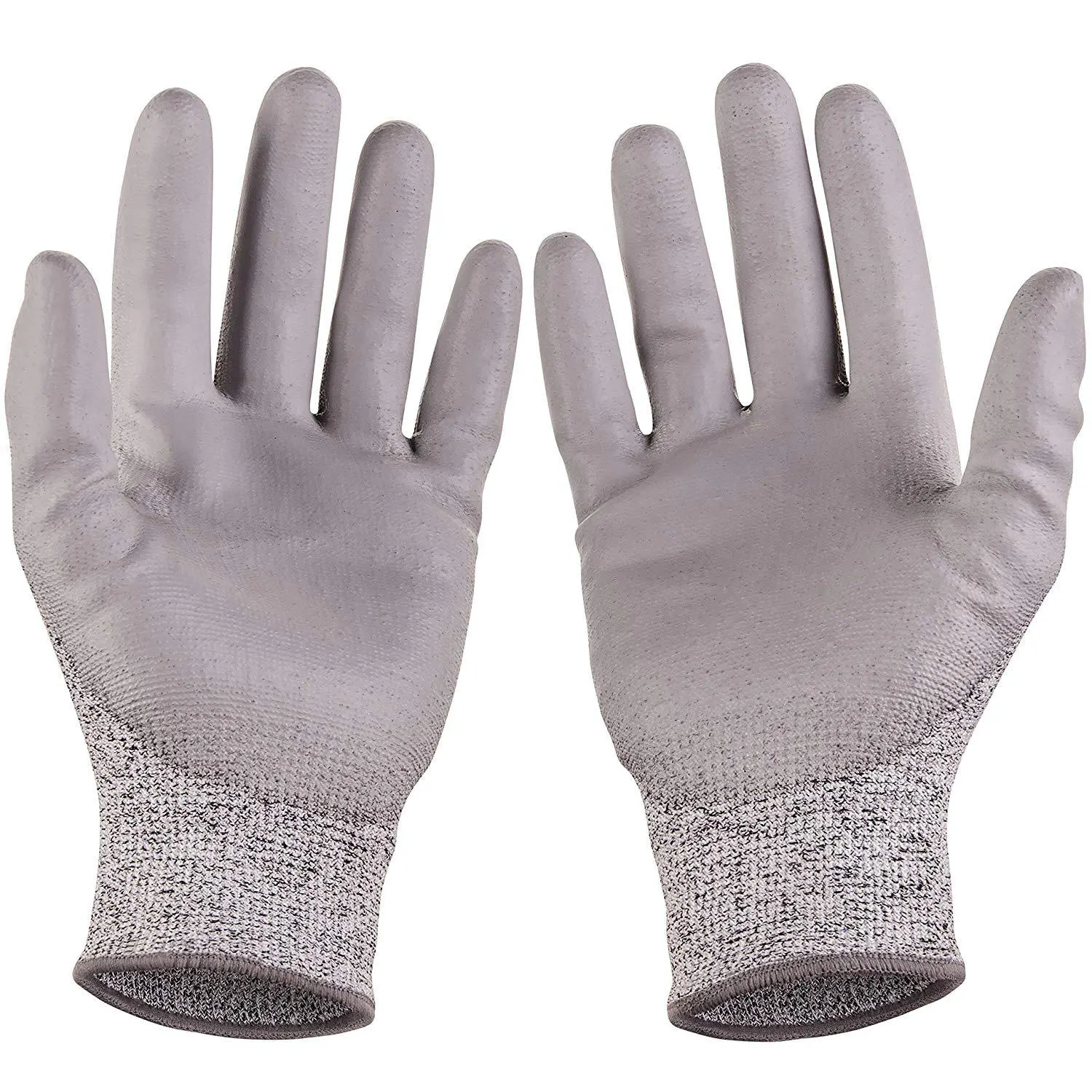
Rilong’s PU palm-coated glove with a 13-gauge anti-cut liner is a product to discuss when preparing a model-specific enquiry. Its listing identifies the construction, but does not establish low-lint, lint-free or cleanroom suitability. Ask for the exact offered liner composition and available cleanliness evidence before considering it for a restricted process.
The page’s LEVEL 5 wording is a separate product claim requiring the corresponding model report and method to be checked. It cannot be converted into an EN or ANSI rating by assumption. A mechanical-protection result also does not answer a fiber-release question. Keep both reviews in the purchasing file without substituting one for the other.
Check what the supplied sample represents
Ask whether the sample has the same construction, finishing, printing and packing as the proposed production order. If a supplier presents an unprinted sample but quotes a printed glove, identify that difference. The comparison should cover the version being purchased rather than an unspecified demonstration pair.
3. Separate visible screening from laboratory evidence
A visual check records what the reviewer can see under stated conditions. It is not a measurement of all released particles or a universal cleanliness certification. If the application requires analytical testing, let the responsible technical team and a qualified laboratory select the relevant method, sample preparation and acceptance criteria.
职业安全与健康管理局(OSHA) IEST-RP-CC005 overview describes evaluation of gloves and finger cots for cleanrooms and other controlled environments, including particle release and other cleanliness properties. That is a relevant technical reference for discussing testing needs. Citing it does not show that a particular glove was tested to it, and this article does not reproduce its test procedures.
When a supplier provides a result, check the report’s model identity, sample description, preparation, measured property and stated limitations. “Pass” without a defined criterion is not enough for a buyer to understand the outcome. A result for another color, liner or finishing treatment needs an applicability explanation rather than a visual comparison.
Request only the evidence relevant to the process. For example, a customer asking about visible fibers may first need a documented observation method; a controlled-environment application may require a broader qualification. Do not imply that a simple desk inspection satisfies either requirement automatically.
4. Keep a useful visible-fiber observation record
Have the process and safety teams approve any sample handling exercise and the materials used. Preserve sample identity and avoid exposing saleable components to an unresolved requirement. The following fields organize observations; they do not prescribe a laboratory method or a protective-glove trial.
| Field | What to record | Why it matters |
|---|---|---|
| 样品 | Supplier, model, revision, size and sample reference | Connect the observation to one candidate |
| As received | Packaging condition and visible material before handling | Separate initial observations from later findings |
| Procedure | Approved instruction and revision used | Make the comparison understandable |
| Contact | Defined surface, hand area and handling sequence | Identify the evaluated conditions |
| Observation | Location, appearance, photographs and timing | Avoid vague reports of “poor cleanliness” |
| Reference | Baseline surface condition and approved comparison sample | Support investigation of possible sources |
| Decision | Reviewer, criterion, unresolved items and scope | Prevent an observation from becoming an unrestricted claim |
Use consistent lighting, viewing conditions and photographic scale where these form part of the approved instruction. Record differences instead of relying on memory. If reviewers cannot agree on what they are seeing, preserve the sample and refer the question for investigation rather than changing the acceptance rule after the result.
For instance, “visible pale fiber near the thumb contact area after the recorded handling sequence” is more useful than “this glove sheds badly.” It still does not identify the material’s source. Keep the source as unconfirmed until the investigation supports a conclusion.
5. Investigate the source and agree the order decision
Review the full handling chain when unexplained material is observed: the glove, packaging, work surface, component, nearby materials and handling practice. Document what was checked and which possibilities remain open. Do not assign the cause to the liner solely because a fiber was found while a glove was in use.
Send the supplier a factual observation package with the sample reference, photographs, procedure and requirement. Ask whether the supplied version matches the approved specification and what additional review or evidence is available. A supplier’s corrective proposal should identify its scope; a general assurance that future goods will be clean is not a replacement for a usable acceptance record.
Keep separate requirements separate. If silicone content is also restricted, the silicone-free claim evidence checklist explains how to frame that enquiry. Neither a silicone declaration nor the absence of a visible mark establishes low fiber release.
Approve only the documented model and process scope. Keep the final wording of any supported claim with its evidence, and explain unresolved limits to receiving staff. If the required documentation is unavailable, retain the candidate as pending instead of adding an unsupported claim to a distributor listing.
6. Carry the evidence into repeat orders
Connect the approved sample, specification and supporting documents to the purchase order. Ask the supplier to flag relevant changes in liner, finishing, printing, source or packaging before supply. Decide who reviews a changed version and how incoming goods will be identified against the approval.
At receipt, check model and configuration identity and follow the agreed quality procedure. Record any discrepancy against the delivered lot or supplier reference. A prior sample approval should remain traceable; it should not become permanent approval of every glove sold under a similar name.
Buyer questions about glove lint
Does washing a sample establish low-lint status?
No. A changed sample condition needs its own documented scope. Do not wash a candidate merely to obtain a better observation unless that preparation is part of the agreed procedure and the supplier’s instructions allow it. Record how the sample was prepared.
Can a product photograph replace a fiber-release report?
No. A photograph can show construction and visible condition at one moment. It cannot supply the method, measured property or result required for a cleanliness claim. Request the evidence tied to the actual model.
Who should approve a customer-facing “lint-free” claim?
The buyer should assign a responsible technical or quality reviewer to assess the proposed wording and evidence. Purchasing can collect the documents, but an unresolved claim should remain unapproved. Avoid strengthening a qualified supplier statement into an absolute promise.
Useful work glove lint checks connect a defined process requirement with identifiable samples, recorded observations and appropriate evidence. To discuss the Rilong PU-coated candidate, send your process-cleanliness and model-documentation requirements with the intended task and sizes. Request the current specification and available evidence before approving the offered version.
