





When a job combines sharp edges with small-part handling, buyers need more than a cut-resistance claim. The glove must suit the actual contact points, let workers grip and release parts, fit the available workforce and carry documentation for the exact model supplied. A polyurethane (PU) palm coating and a cut-resistant liner can be a useful construction to evaluate, but a material description alone does not establish protection for a particular task.
This checklist is for importers, distributors, procurement teams and safety managers comparing PU-coated cut-resistant work gloves for repeated orders. It separates what a product page can tell you from what a sample trial and model-specific test report must establish. No glove should be approved for a workplace solely on the basis of this article.
Define the handling task before comparing models
Start with the object, not the glove catalog. Describe whether the worker handles stamped components, sheet edges, fasteners, cartons with staples, glass, or another item. Record where the hand meets the hazard: fingertips, palm, thumb web, back of hand or wrist. Note whether the worker is guiding an object, gripping it under load, or using a tool nearby. These details help determine which parts of the glove need coverage and what level of dexterity the task demands.
Ask the safety team to document the applicable risk assessment. The U.S. Occupational Safety and Health Administration (OSHA) advises selecting hand protection for the actual hazard and asking the manufacturer for documentation against the relevant test standard. The UK Health and Safety Executive (HSE) likewise recommends considering other hazards, the task, the wearer and the duration of use. A glove that helps with one exposure does not necessarily address puncture, impact, heat or chemical contact.
What the PU palm and liner each contribute
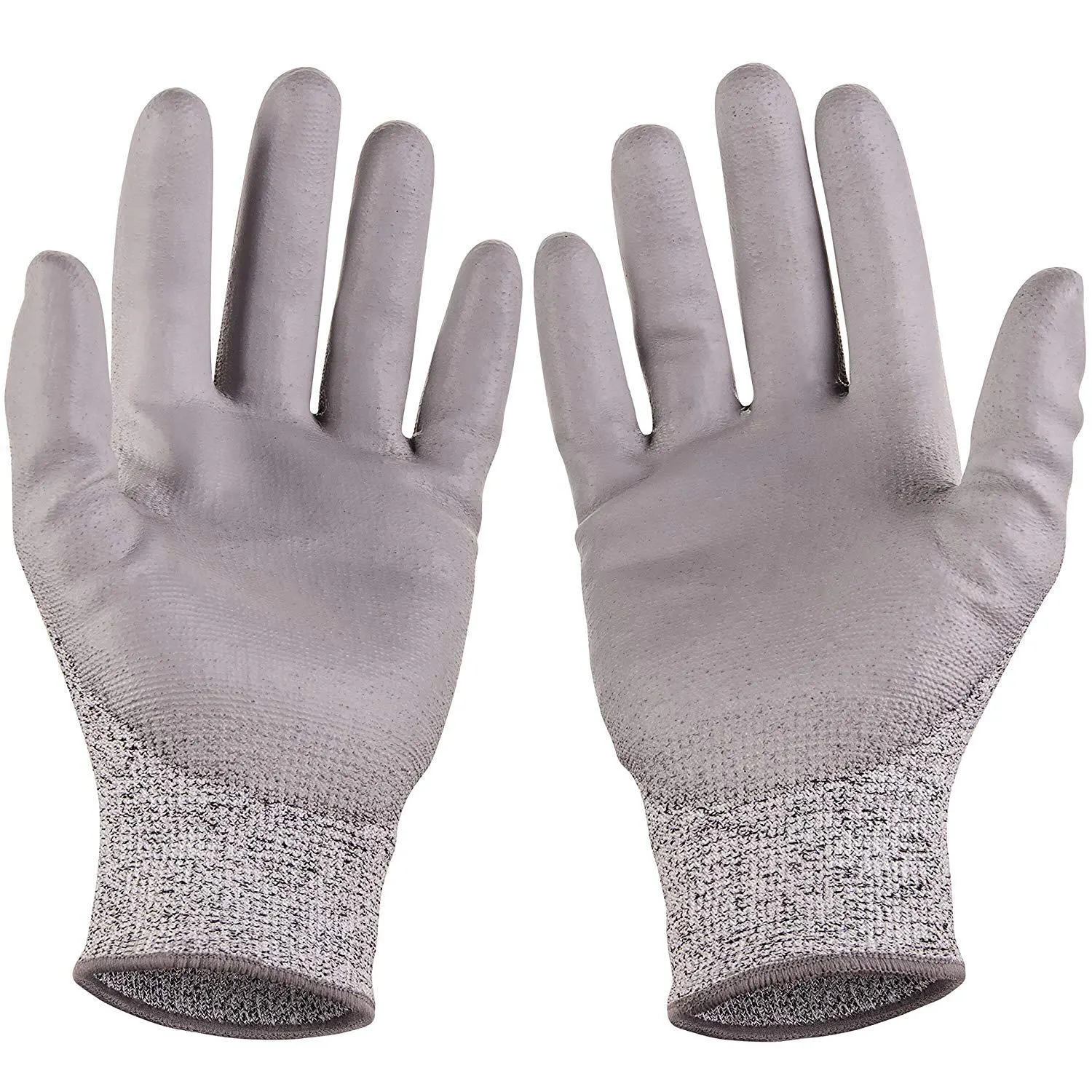
A PU-coated palm is a surface for gripping and handling. Its thickness, coverage and finish should be checked on the exact offered sample. The knit liner influences fit, flexibility and the cut-resistance construction. These are separate attributes: a coating cannot be assumed to create a cut rating, and a cut-resistant yarn cannot be assumed to give the palm the grip needed on the buyer’s parts.
Rilong lists a 13-gauge PU palm-coated cut-resistant work glove under the product name “Level 5 Cut-Resistant.” Its short description asks buyers to confirm sizing, specifications and the test report for the model. Treat “Level 5” as a listing claim to verify against a report for the specific construction and destination-market marking, not as a rating this article independently confirms. The phrase also needs the relevant test method and edition to be meaningful; do not transfer it to a different yarn, gauge, coating or color variant without evidence.
Check coating coverage on the sample
Inspect both hands of several sample pairs. Is the coating confined to the palm and fingers, or does it extend around the sides? Are the thumb and fingertips uniformly covered? Does the knit back remain exposed? These observations matter because the surface a worker contacts may differ from the face shown in a catalog photo. Record a close-up image of the actual approved sample and annotate any permitted variation.
If an object has oil, coolant or another residue, identify that substance and assess whether it creates a separate skin-exposure hazard. A PU palm coating is not, by itself, evidence of chemical protection. Do not turn a successful handling trial into an unsupported chemical-resistance claim.
Ask for the exact cut-protection evidence
Where cut protection is required, request the report and user information for the specific offered model. Record the model identifier, tested construction, test method and edition, reported result, report date and responsible laboratory. Compare those details with the product label, carton and sample. If the quotation includes alternate liners, coating recipes or factories, ask whether each configuration is covered by the same evidence.
EN 388:2016+A1:2018 is listed in EU harmonised-standard references as a standard for protective gloves against mechanical risks. That reference does not make every glove displaying “EN 388” or “Level 5” suitable for every sharp-object task. Buyers should have the relevant safety or compliance specialist interpret the report and the destination-market requirements. Rilong’s work glove test-report checklist can help structure this document review.
Keep test claims precise in catalogs and RFQs. Avoid a bare “cut-proof” promise: gloves can reduce specified risks, not eliminate them. If a supplier cannot map the advertised claim to the offered model and report, leave the claim out of customer-facing material until the gap is resolved.
Build a fair field trial for precision handling
Laboratory data and real-task usability answer different questions. For a field trial, use the actual component, tools and workstation, with controls approved by the site safety team. Give each candidate glove the same task and observation period. Record whether workers can pick up a part, rotate it, align it, operate controls and release it without awkward extra force. Note any snagging, coating wear or repeated adjustments.
Fit should be evaluated across several hand sizes, not on one buyer or one sample pair. A glove that bunches at the fingertips may hinder accurate placement; a glove that is too tight may restrict movement and encourage workers to remove it. Ask users about comfort after the expected wear period and compare feedback against the safety requirements. Do not trade away an essential protection requirement merely to improve speed.
Include a replacement decision in the trial record. Identify visible signs such as holes, cut yarn, detached coating or loss of grip that should take a pair out of service. The decision should be tailored to the worksite and the manufacturer’s instructions; this article does not prescribe a universal wear life.
Write the RFQ so quotes are comparable
A useful RFQ ties the hazard assessment, sample and commercial quote to one defined construction. Request the following in writing:
- Model and revision: Unique product identifier and the version to which test evidence applies.
- 建設現場: Liner yarn specification, knit gauge, coating material, palm coverage, cuff style and proposed colors.
- Size range: Size chart, sample sizes and the method for confirming order ratios.
- Claims and documents: Exact mechanical-protection wording, report, marking and user information relevant to the destination market.
- Samples: Representative pairs from the quoted construction for fit and controlled handling assessment.
- パッケージング: Label artwork, model name, size identification and any required buyer information.
- Change control: Process for approving material, coating or production changes before a reorder.
Do not fill unknowns with an assumed MOQ, lead time or rating. Ask the supplier to quote these for the specified model and order quantity. If a proposed substitution changes the tested construction, reopen the document and trial review before accepting it.
Compare the total decision, not one headline number
A procurement matrix should show separate columns for hazard evidence, task handling, fit, consistency and commercial terms. This makes trade-offs visible. A higher-sounding claim does not replace good fit, and a comfortable trial does not replace model-specific protection evidence. If a candidate fails a mandatory safety criterion, do not average that failure away with price or comfort scores.
Before an initial bulk order, retain one approved reference sample with its identifier and specification revision. For repeat orders, compare incoming gloves with that reference and the agreed documents. Rilong’s golden sample control guide outlines a practical record for reorders without assuming that every batch is identical.
Questions to ask before approving a “Level 5” listing
- Which exact model and construction does the claim cover?
- Which test method, edition and report support the number or level shown?
- Does the report identify the same liner, coating and design as the sample?
- What other hazards are present at the worksite, and which are outside this glove’s documented scope?
- Do available sizes and the tested fit support the intended workforce?
- What changes would trigger a new sample and document review?
These questions are particularly important where a product name is used across several variants. A distributor should be able to show a clear chain from online listing to approved sample, test evidence, sales specification and delivered carton.
結論
PU-coated cut-resistant gloves should be selected as a complete, model-specific solution for the assessed task. Verify the cut claim, examine coating coverage, trial real handling and fit, then lock the approved construction into the purchasing record. A product image can illustrate the glove’s appearance, but it cannot prove a protective rating.
Explore Rilong’s PU-coated cut-resistant product page as a starting point. To discuss a quote, send Rilong the application, destination market, target sizes and required documentation; ask for the current model-specific specification and test report before final approval.
