





Silicone-free work gloves are sometimes requested with little more than a sentence in a purchase order. For a buyer handling components before finishing or assembly, that sentence needs a clear meaning, an identified model and evidence that addresses the actual requirement. A coating name or a clean-looking photograph is not enough.
This guide explains how to turn a silicone-free request into questions a supplier can answer and a buyer can review. It does not declare any Rilong model silicone-free, set a universal contamination limit or replace the customer’s process qualification. Keep material declarations, analytical results and application approval separate.
Start with the customer’s process requirement
Ask why the restriction exists and where the glove will contact the product. Identify the component, contact stage and downstream operation. A receiving team moving packed cartons has a different question from a team directly touching an exposed surface before finishing. The process owner should define what must be controlled, rather than leaving the glove supplier to infer it.
Silicone-free claims do appear in manufacturers’ product information for relevant applications. For example, Portwest’s A930 product page associates its own model’s silicone-free feature with work where silicone is problematic, including paint applications. That is a model-specific manufacturer statement, not evidence for another manufacturer’s glove or for every task.
Obtain the customer’s written requirement and revision. If it refers to an internal test or approved-material list, ask who can interpret it and approve a candidate. Do not translate a customer’s short phrase into an invented laboratory threshold. If the requirement is unclear, record the open question before requesting quotations.
Clarify exactly what the supplier is declaring
Ask the supplier to explain the wording it proposes to use. Does it describe ingredients intentionally added to a formulation, a reviewed manufacturing process, a particular test result or a customer-approved application? These are different statements. A declaration addressing intentional addition should not silently become a claim of zero detectable residue.
Also clarify scope. Does the response cover only the palm coating, or the complete glove including liner, cuff, printing and any finishing treatment? Does it apply to the standard version only, or also to a private-label logo and custom packaging? The buyer needs an answer for the actual supplied configuration.
Questions to send with the inquiry
- What exact claim can you support, and what does that wording mean?
- Which model, construction revision, colors and manufacturing source does it cover?
- Which components, treatments and printing options are included or excluded?
- What documents support the statement, and who issued them?
- What changes would require a revised declaration or another review?
Do not request confidential formulation details unnecessarily. A scoped declaration, a controlled specification and an appropriately designed test may be more useful than a long ingredient list that nobody has mapped to the purchase requirement. The process owner’s acceptance criteria determine what evidence is needed.
Do not infer silicone-free status from PU coating
PU, nitrile and latex identify broad coating families. None of those names, by itself, answers a specific question about every ingredient, treatment or possible transfer source in the finished article. Ask for evidence instead of turning a material abbreviation into a purchasing guarantee.
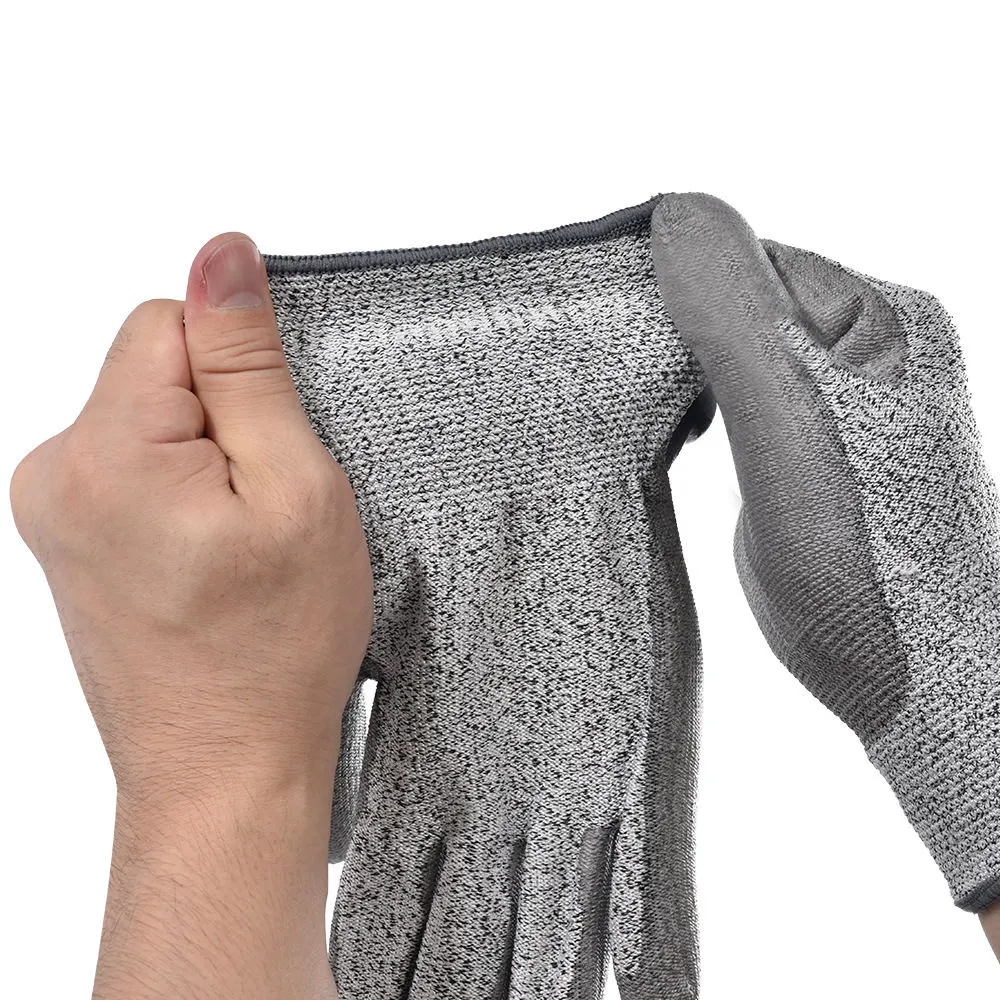
De Rilong PU-coated glove with a 13-gauge anti-cut liner is a model to discuss when assembling a sample inquiry. Its listing does not establish silicone-free status. Request the current model-specific response before considering it for a silicone-restricted process, and leave the claim unapproved if the required evidence is unavailable.
The page’s Level 5 wording is a separate listing claim that needs its corresponding report and method verified. It must not be converted into an EN or ANSI result by assumption. Equally, a mechanical protection result would not resolve a silicone-content or surface-transfer question. Keep the protection review and the process-cleanliness review in separate fields.
Match every document to the offered version
A useful document identifies the supplier, model, scope, issue date and the version or configuration being covered. Check whether the sample label and quotation can be connected to that identity. A generic letter stating that a factory makes silicone-free gloves is weaker than a response that clearly covers the exact candidate.
If analytical testing is required, ask a qualified laboratory and the customer’s technical team to agree the method and acceptance criteria. Review what was sampled, what was measured, how the sample was prepared and what limitations apply. Do not equate an unspecified pass with a guarantee that nothing can transfer during every production process.
Where a report uses a detection or reporting limit, retain that context with the result. Do not rewrite a qualified laboratory conclusion as absolute zero. If the documentation covers another color, print treatment or manufacturing source, request an explanation of applicability rather than accepting visual similarity as proof.
Keep other cleanliness claims separate
Silicone-free, non-marking, low-lint and cleanroom-related descriptions answer different purchasing questions. Evidence for one should not be reused automatically for another. A glove could pass a buyer’s visible color-transfer check without that observation establishing its chemical composition. Likewise, a declaration cannot establish a visual outcome on every finished surface.
El guide to checking visible color transfer provides a complementary observation workflow. Use it only where that separate concern is relevant. Do not rename a simple wipe or handling demonstration as a silicone test, and do not treat the absence of a visible mark as analytical evidence.
Qualify samples without risking saleable production
Let the customer’s responsible process and safety teams define any application trial. Use identified samples and an approved procedure that does not expose workers or saleable goods to an unresolved risk. Confirm protection requirements before trial use; process compatibility is not a reason to overlook hand hazards.
Record the glove model, size, color, revision, packaging condition and date received. Keep the relevant documents with that record. If the process owner requires a specific comparison or downstream evaluation, retain the procedure and its result rather than summarizing everything as “works well.” State which conditions were assessed and which remain unverified.
Sample acceptance should have a named decision owner. Procurement can assemble the evidence, but an unresolved technical requirement should not disappear merely because a quotation is attractive. If a supplier cannot provide a required document, retain the candidate as pending or choose another documented option.
Protect the approved configuration on reorders
Attach the accepted claim wording, supporting document references and approved configuration to the order record. Ask for advance notification of changes that could affect the reviewed requirement, including relevant material, treatment, printing, source or packaging changes. Agree how the supplier will identify the version shipped.
At receipt, check that model and configuration identity match the approval. Preserve records that connect delivered goods to the supplier’s statement. A previous approval should not be transferred automatically to a substituted model. Where the customer requires periodic review or renewed testing, document that requirement without inventing a universal renewal interval.
Conclusion: approve evidence, not a coating label
A dependable silicone-free work glove inquiry defines the customer’s requirement, the supplier’s exact statement and the evidence connecting it to one offered configuration. It also keeps protection, visible transfer and process qualification distinct. Unknown status should remain unknown until the appropriate review is complete.
To discuss a Rilong candidate, send the team your material-restriction and documentation requirements with the intended process and target model. Ask what current evidence is available before approving samples or using a silicone-free claim in your own product information.
