



A catalog description can make two sandy nitrile gloves sound interchangeable. In a bulk order, small differences in liner feel, coating coverage, size consistency and the surface actually handled can make one sample more suitable than another. A buyer therefore needs a repeatable way to compare the offered glove with the worksite task and with the version that will arrive later.
This guide focuses on a 15-gauge sandy nitrile palm-coated work glove as a sourcing example. It is written for importers, distributors, safety managers and procurement teams. It does not assign a protection rating, promise performance on oily surfaces or replace a workplace risk assessment. Those decisions require the exact model, current documentation and controlled trial conditions.
Start with the handling problem, not the coating name
Write down what workers actually pick up: cartons, painted parts, tools, molded components or another material. Note the object’s mass and dimensions, whether it is dry or carries residue, how often it is lifted, and whether workers need to rotate or align it precisely. A glove that feels secure on a clean carton may behave differently on a smooth component with coolant. The trial should use the real object and a supervised procedure approved by the site safety team.
Record the contact points on the hand. Is the palm bearing the load, or do fingertips control a small part? Does the back of the hand brush against equipment? Is there a separate risk from sharp edges, impact, heat or chemicals? A textured nitrile palm is not evidence of protection against every one of those hazards. Make mandatory safety criteria explicit before anyone compares comfort or price.
Define what a successful trial looks like
For each representative task, describe observable outcomes: the worker can pick up, transfer and release the object without unexpected slips; the glove allows normal controls to be operated; and the worker does not need to grip with excessive force. Record when the trial was conducted, the object and its surface condition, the glove size, the worker feedback and any visible wear. Avoid converting these observations into a universal numerical grip claim.
Confirm the exact offered construction
The Rilong listing identifies a 15-gauge liner and a sandy nitrile finish, but the current product page also presents alternative liner and coating descriptions. That is a reason to request a model-specific specification, not to assume every listed option is in the same glove. Ask the supplier to identify the exact yarn blend, coating location, cuff construction, color, size range and internal model or revision code on the quote and sample label.
Gauge describes the knitting construction; it is not, by itself, a claim about cut protection, dexterity or durability. Compare the actual sample’s thickness and stretch with the offered specification. Ask whether a color change, liner substitution or altered coating recipe would be quoted as the same model or as a new variant requiring approval.
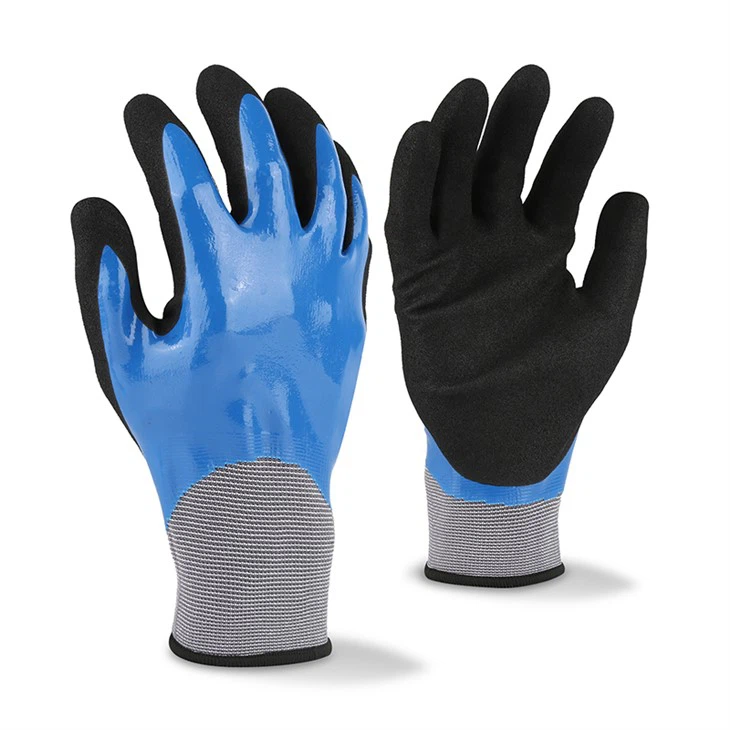
Coverage deserves a close look. Photograph the palm, thumb, fingertips, finger sides, knuckles and cuff of the sample. Some product listings group palm-coated and fully coated options together, yet those are materially different constructions. Mark the intended coverage in the purchase specification and compare every candidate against it. Rilong’s coating-coverage guide explains how to describe the boundary in a buyer-friendly way.
Inspect a representative sample set
One pair can show the concept but not the size range or production variation. Request several pairs across the sizes expected in the order, ideally with enough samples for both desk inspection and a controlled handling trial. Log the supplier, date received, model identifier and any batch or sample code. Keep the packaging and label with the pair so its identity is not lost after testing.
Check the pairs side by side under consistent light. Are the coating edges, thumb areas and fingertip coverage reasonably consistent? Are there visible voids, thick lumps, peeling areas, loose yarns or misplaced seams? Does the cuff recover after stretching? These are screening observations rather than a substitute for formal inspection criteria. If a defect matters to the buyer, define it in the approval record with a photograph and a clear acceptance rule.
Measure the sample in a way that can be repeated: overall length, palm width and, if needed, the distance to the fingertip or coating boundary. Write down the method and tolerances agreed with the supplier. A dimension without its measurement method can lead to disputes. Confirm that the size label, packaging and actual fit correspond.
Separate fit from performance claims
Ask trial users to report bunching at the fingertips, pressure across the knuckles, cuff tightness and difficulty removing the glove. Observe whether users repeatedly adjust or remove it. Test several hand sizes rather than letting one buyer choose the size range for an entire workforce. Do not relax a mandatory protection requirement simply because a more flexible sample feels comfortable.
Run a controlled grip and handling comparison
Compare candidate gloves on the same workstation, object and handling sequence. If the task includes dry, damp or residue-covered items, distinguish those conditions in the record. Do not deliberately introduce a hazardous contaminant merely to test a glove. The worksite safety lead should decide what is safe to trial and what needs a different protective product or engineering control.
Note the motion that causes difficulty. Is the item hard to lift initially, to rotate in the fingers, to hold while a tool is used, or to release cleanly? Record slips, extra squeezing, fatigue complaints and changes in handling time as observations, not as laboratory ratings. If the process involves a sharp edge, obtain the relevant model-specific cut evidence rather than assuming the nitrile coating addresses it.
The image of a textured palm can help identify a sample, but it cannot demonstrate a wet-grip coefficient, abrasion level or chemical barrier. A prior Rilong article on nitrile-coated versus chemical-resistant gloves explains why a coated handling glove should not be marketed as chemical protection without evidence for the exact construction and substance.
Build an RFQ that yields comparable quotations
Send every supplier the same task description and request the following fields in writing:
- Identity: model code, revision, sample reference and manufacturing source for the quoted configuration.
- Bauweise: 15-gauge liner details, yarn composition, coating material and finish, coverage boundary, cuff and available colors.
- Passform: size chart, measurement method, proposed size range and samples for the expected workforce.
- Evidence: the exact test reports and user information supporting any mechanical, chemical or other protective claims made for this model.
- Verpackung: pair, inner-pack and carton labeling; model, size and batch identification; and any market-specific artwork to approve.
- Commercial terms: quoted minimum order quantity, price basis, lead time and delivery terms for the specified order, rather than values copied from a generic product page.
- Change control: what happens if yarn, coating, factory or packaging changes before or after the first order.
Do not assume a website’s MOQ or size list applies to the exact offered version. Ask for a dated quotation linked to the same model code and sample. If a supplier offers a substitute, request a fresh comparison of the changed attributes instead of silently treating it as equivalent.
Lock the approved version before ordering
After the safety and purchasing teams agree on a candidate, keep an approved reference pair, photographs, specification revision, label artwork and the associated test documentation. Record who approved each item and when. This gives the receiving team something concrete to compare with the bulk shipment. A sample is not a promise that every delivered pair is identical; it is a controlled reference for checking whether the supplied product matches what was bought.
Before dispatch, agree on inspection scope and how nonconforming goods will be reported. At receipt, select pairs from different cartons and sizes, check identity and visible construction, and document any variance. If a batch differs from the approved sample, isolate it for review rather than changing the specification after the fact. Supplier responsiveness to documented questions is part of the sourcing decision, not merely an after-sales issue.
Buyer decision checklist
- Have we described the real handling object, surface condition and separate hazards?
- Does the quotation identify one exact 15-gauge liner and sandy nitrile coating construction?
- Do sample photos show the agreed palm, fingertip and back-of-hand coverage?
- Have representative workers trialed suitable sizes under controlled conditions?
- Are every advertised protection claim and destination-market marking supported by model-specific documents?
- Are size ratios, packaging, commercial terms and substitutions written into the purchase record?
- Can receiving staff trace the shipment back to the approved sample and specification?
A “yes” should be supported by a record, not by a catalog phrase. If the answer is unknown, leave it open in the RFQ and ask the supplier to clarify before approval.
Fazit
Sandy nitrile is a useful coating description, but a successful bulk buy depends on the exact construction, fit, documented protection scope and performance in the buyer’s handling task. A disciplined sample trial and RFQ make those factors visible before a purchase order is issued. They also make later reorders easier to inspect and discuss.
To evaluate Rilong’s 15-gauge option, review the product listing und contact Rilong with your application, destination market, expected sizes and requested documents. Ask for the current model-specific specification, representative samples and quotation before making a final selection.
