





Choosing a work glove starts with the task, not the coating name. A glove suitable for moving dry cartons may be unsuitable for sharp sheet metal, chemical contact, hot work, or oily parts. For importers, distributors, and safety teams, the goal is to define the hazard, compare documented performance for the exact model, and trial the fit in the workplace.
This is general purchasing guidance, not a substitute for a workplace risk assessment or model-specific test documentation.
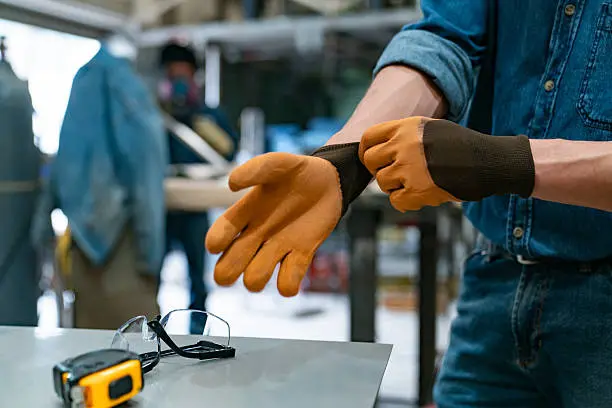
Start with the hazard and work conditions
List what the hand contacts: rough surfaces, sharp edges, moving parts, heat, cold, liquids, or particular chemicals. Record whether contact is occasional or continuous, expected wear time, and the dexterity needed. Assess grip in the actual dry, wet, or oily condition rather than assuming performance from a material label.
OSHA recommends considering glove performance characteristics for the anticipated hazard and requesting documentation that the glove meets appropriate test standards. It also highlights dexterity, exposure duration, and physical stresses.
Coated knit gloves: liner, coating and coverage
A coated knit glove combines a textile liner with a coating on part or all of the outer surface. The liner affects fit and feel; the coating and its texture affect handling. Neither the polymer name nor appearance alone proves a protection level. Compare the exact construction, coverage, and model test results.
Latex-coated styles
Natural-rubber latex coatings come in different textures and liner combinations. They may be shortlisted for material handling when the required grip and fit are confirmed by a task trial. Account for latex sensitivity among users. Do not infer chemical compatibility from the word “latex.”
Nitrile-coated styles
Nitrile-coated knit gloves are often considered for parts handling where grip, wear, and dexterity matter. A palm-dipped knit glove leaves uncoated areas and is not automatically a chemical-protective glove. For liquid or chemical exposure, identify the substance, concentration, exposure time, and contact pattern; request chemical-resistance data for the specific complete glove. The UK HSE advises relying on manufacturer data because performance varies between products.
PU-coated styles
Polyurethane-coated knit gloves may be compared for fine handling and assembly where tactile feedback matters. Trial grip, durability, and comfort in the actual process. “PU” alone does not establish cut resistance, ESD control, cleanroom suitability, or chemical protection.
Coverage also matters: palm dip, three-quarter dip, and full dip are not interchangeable. See our coating coverage guide for the specification questions to ask.
Cut-resistant gloves: compare the tested model
Select cut-resistant gloves for a defined sharp-edge task, not because a product name says “cut-proof.” Yarn, construction, coating, and fit differ between models. Ask for the applicable test report or declaration for the exact model and check that its method and rating fit the destination market and workplace requirement. Cut resistance does not imply protection against puncture, powered blades, heat, or chemicals.
During a trial, check whether workers can grasp the material without removing the glove. Browse the anti-cut glove category for a shortlist, then request model-specific evidence rather than treating a category page as a certification record.
Leather, impact, and temperature-specific gloves
Leather gloves vary by hide, thickness, seams, cuff design, and lining. For welding or hot work, match the glove to the process and request relevant model-specific thermal and mechanical evidence. Leather alone does not establish a welding rating. Check dexterity and seams with the actual tools and workpieces.
Back-of-hand impact features do not prove protection against every pinch or crush hazard. If impact is a requirement, ask which method tested the exact glove and where its protective elements are located. For cold-weather styles, evaluate insulation, grip, moisture exposure, and task duration; a warm lining does not automatically make a glove waterproof.
A practical buyer’s comparison checklist
- Define the job: Record primary and secondary hazards, contact surfaces, temperature, moisture or oil, and expected wear time.
- Identify the exact model: Request model code, liner and coating materials, coverage, cuff style, and size range. Avoid generic family descriptions.
- Check evidence: Ask for reports or declarations relevant to the destination market and each claimed characteristic. Match model identifiers across the offer, label, and documents.
- Trial fit and handling: Sample relevant sizes with actual users and representative tasks. Record grip, dexterity, comfort, and visible wear.
- Confirm supply details: Agree on labeling, packaging, size ratios, sampling, and inspection criteria. Request commercial terms and lead time for the actual quantity and configuration.
For chemical exposure, add the substance name, concentration, duration, and contact pattern to your inquiry. For cut, heat, or impact hazards, specify the destination market and required test method. This lets the supplier propose a shortlist without guessing at protection claims.
Build a defensible shortlist
The best glove is one whose documented performance fits the hazard and whose design workers can use consistently. Start with a task specification, compare exact models, and keep test evidence with the procurement record. Review Rilong’s product catalogue, then contact our team with your application, target market, sizes, and evidence requirements to discuss samples.
Further reading: OSHA PPE selection guidance و HSE guidance on choosing gloves.
